Stop Playing the MOQ Game: A Smarter Way to Scale Your Brand에 댓글 닫힘
목차
Most brand founders treat MOQ (Minimum Order Quantity) as an obstacle to negotiate around. They push, plead, and sometimes walk away from good factories because the numbers feel too high.
Here’s the thing: you‘re playing the wrong game.
A factory’s MOQ isn’t a barrier designed to keep small brands out. It‘s a structural signal about how their operation is built. Stop trying to “win“ the negotiation — and start using MOQ as the strategic tool it was meant to be.
What MOQ Actually Tells You (That Most Buyers Miss)
When a manufacturer quotes a high MOQ, they‘re not being difficult. They’re telling you something real about their fixed costs:
Production line setup.A vacuum-insulated bottle passes through 40–60 process steps before it‘s finished. Each setup takes hours and is amortised over the run quantity. Below a certain volume, the per-unit cost makes the job uneconomical for both parties.
Tooling economics.High-volume manufacturers invest in hardened steel, multi-cavity moulds rated for millions of cycles. That investment delivers the dimensional consistency that makes your product look identical across a 10,000-unit run — but it needs volume to justify.
Quality system overhead.A factory running BSCI audits, ISO 9001 certification, in‑process SPC, and outbound QC inspection carries a cost per batch that a small factory simply doesn‘t incur. That overhead has to be spread across enough units to land at a competitive per-unit price.
When a manufacturer quotes you an MOQ, the number is telling you something real about how their operation is structured. Pushing aggressively below it doesn’t get you a better deal — it gets you a reluctant run on equipment that isn‘t optimally configured for your volume. And that usually shows up in quality.
The takeaway:Stop negotiating against MOQ. Start reading it.
Why Chasing Low MOQs Can Kill Your Brand
The global stainless steel water bottle market was valued at USD 2.87 billion in 2025, with projected growth to USD 5.33 billion by 2035 at a CAGR of 6.37%. That’s a large and growing opportunity. But here’s what actually limits most brands — not market size, but poor MOQ strategy.
Low MOQ suppliers often carry hidden costs that don‘t appear on the initial quote:
Batch inconsistency.Color variation, dimensional drift, and finish defects are significantly more common across small-factory batches. A study on startup inventory risk found that style failure risk multiplies with MOQ requirements — a single design that doesn’t resonate with customers can saddle you with thousands of pieces of dead inventory that tie up cash and warehouse space.
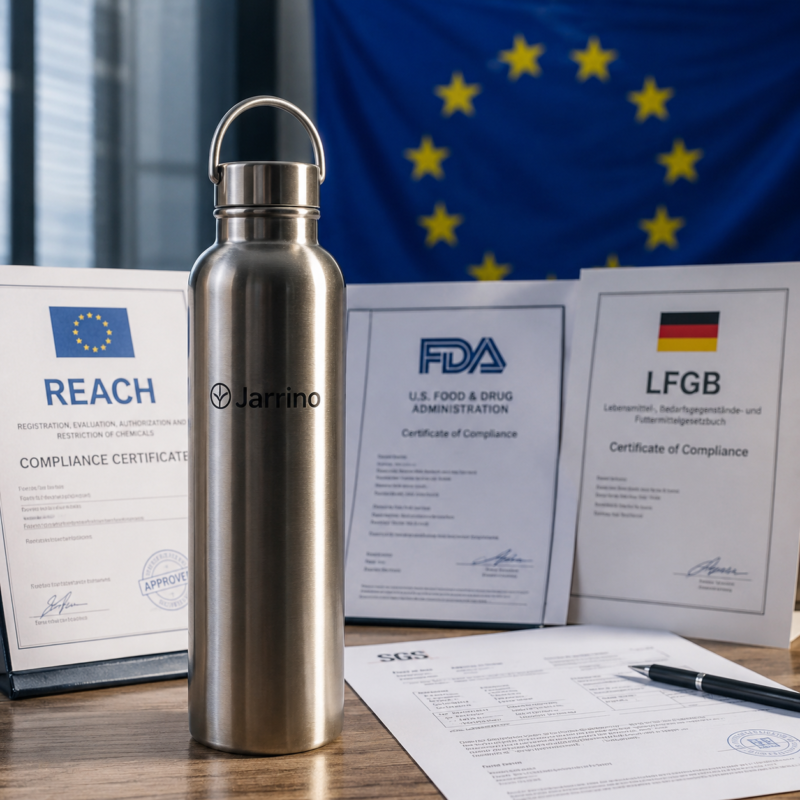
Certification gaps.If your market requires LFGB, FDA, or Prop 65 compliance documentation, a small factory that can‘t provide audited test reports isn’t a real option — regardless of how low their MOQ is.
Scale penalties.The factory that accepts 500 units may look cheaper on paper. But when you need 10,000 units six months later, their per-unit cost stays high, their lead time stretches, and their quality control breaks under pressure.
A supplier with a1,000-unit MOQ 그리고 dedicated production lineswill consistently outperform a 300-unit supplier that squeezes your order between other jobs. The higher number isn‘t the enemy — it’s often the better partner.
How to Build an MOQ Strategy That Scales With You
Instead of fighting MOQ, build a strategy that works with it. Here‘s how experienced brand owners approach this.
1. Map Your Volume Tiers — Then Price Them
Most brands treat MOQ as a single number. Smarter brands think in tiers.
Order volume
What unlocks
Price movement
At MOQ threshold
Production run viable
Full per-unit cost
2–3× MOQ
Preferred run size
5–8% reduction typical
5–10× MOQ
Dedicated line allocation
Meaningful tiered discount
10× MOQ+
Strategic partnership
Best achievable pricing
Volume‑based tiered pricing works because it rewards commitment. Customers who commit to higher volumes feel rewarded through better pricing, making them more likely to return. Tiered pricing fosters long-term relationships by providing tangible value as purchasing levels grow.
Share this tier structure with your factory. Say: “We‘re planning 3,000 units this year. We’ll take 1,000 now, then reorder every quarter. Can we lock in the 3,000‑unit price?”
Most factories will say yes. They‘d rather see a predictable annual volume than fight over every purchase order.
2. Negotiate the Whole Package, Not Just the Number
Experienced B2B buyers use a more complete approach. Smart negotiators don’t focus on MOQ alone — they negotiate the entire deal: unit price, 모크, payment terms, lead time, 포장, labeling, and quality control together.
When you’re at the table, bring multiple leverage points:
Payment terms.Offer a larger deposit or faster payment schedule. Factories discount for cash flow certainty.
Forecast visibility.Share your 12-month volume projection. Manufacturers will often lower MOQ for buyers who show predictable reorder patterns.
Consolidated SKUs.Order multiple colorways or designs in the same run. Setup costs are shared, so MOQ per SKU often drops.
One effective strategy is to offer to pay a separate machine setup fee or a higher per-unit cost for the first run in exchange for a lower MOQ. This aligns incentives: the factory doesn’t lose money on the setup, and you get the lower volume you need to start.
3. Use Framework Agreements for Phased Delivery
A well-structured supplier relationship doesn‘t require you to take delivery of the full MOQ at once. Framework agreements — long-term contracts often lasting one to four years — define the terms and conditions without obligating either party to purchase or deliver until a call-off contract is executed.
What does this look like in practice? You commit to 6,000 units over 12 months. The factory gives you the 6,000-unit price. But you take delivery in three shipments of 2,000 units each, spaced every four months.
This gives you production continuity and pricing stability without a single large inventory event. And critically, the framework approach can reduce inventory costs by up to 30% through demand-driven just‑in‑time deliveries.
The Two Paths to Market — and Which MOQ Works for Each
Not every brand needs the same MOQ structure. The right number depends on how you‘re going to market.
Private Label (ODM)
You take an existing factory design and add your logo, 그림 물감, 포장, and sometimes finishes. The factory handles the mould and production engineering.
Typical MOQ: 200–1,000 units per design/color
Advantage:Fastest path to market, lowest upfront investment
Trade‑off:Limited differentiation; other brands may use similar silhouettes
Full OEM
You develop a completely new bottle shape, lid mechanism, or surface finish. Tooling is custom to your specifications.
Typical MOQ: 3,000–10,000+ units
Advantage:True differentiation; your product looks like nothing else on the shelf
Trade‑off:Higher upfront investment; longer lead times
Higher customization (OEM) means higher cost, longer lead time, more risk of error — but higher reward in brand differentiation. Lower customization (ODM) means lower cost, faster market entry, but less differentiation and possibly higher competition.
Which path is right?Start with ODM. Prove your product-market fit. Build reorder volume. Then migrate your hero SKU to OEM once you know it sells.
Making the Switch: A 12-Month MOQ Roadmap
Here‘s how to stop fighting MOQ and start using it strategically, month by month.
Month 1–2: Research and Validation Order physical samples from at least two suppliers at different MOQ tiers. Compare not just price, but coating quality, lead time transparency, and certification documentation.
Month 3–4: Private Label Pilot Place your first ODM order at the lowest MOQ the supplier offers. Focus on one core product, not six variations.
Month 5–6: Market Testing Get your product in front of customers. Capture feedback obsessively. Identify which colors, 크기, and finishes actually move.
Month 7–9: Reorder and Scale Place your second order at 2–3× your initial volume. Use the volume tier to negotiate better pricing. Show the factory your 12‑month forecast.
Month 10–12: OEM Migration (Optional) If a specific SKU is consistently selling out, take it to full OEM. Develop your own mould, own the tooling, and lock in exclusivity.
This isn‘t a guess-and-hope approach. It’s a structured plan built on actual market data, not assumptions.
The Volume Advantage Nobody Talks About
As you scale, your relationship with your factory transforms. At 5× MOQ, you typically move from “standard customer“ to “dedicated line“ status. Lead times shorten. Quality improves. The factory starts offering you first look at new finishes and capabilities.
This isn‘t because they like you more — it’s because you‘ve become operationally important to them. The MOQ that felt like a barrier in year one becomes the foundation of a strategic partnership in year three.
Volume‑focused businesses benefit from faster inventory turnover and compounded profits through scale. What feels like a stretch at the start becomes the engine of sustainable growth.
Global demand for this material is driven by its strength, 부식 저항, and superior thermal insulation — demand that’s projected to grow consistently over the next decade. Those who build the right supply relationships now will capture the most value as the market expands.
Start the Right Way
You don‘t need a massive first order. You don’t need custom tooling before you‘ve sold a single unit. But you do need a partner willing to work with you on a roadmap — not just a purchase order.
Jarrino에서, we don’t believe MOQ should lock you out. We‘ve helped hundreds of B2B buyers navigate from small test runs to full production scale. Our approach isn’t “our number or nothing.” It‘s “tell us where you’re going, and we‘ll build a plan to get you there.”
A few hundred pieces. A thousand. Twenty thousand. Every brand starts somewhere.
The game isn‘t beating MOQ. It’s understanding what it really means — and using it to grow.
📧Ready to build your MOQ strategy?Contact our team
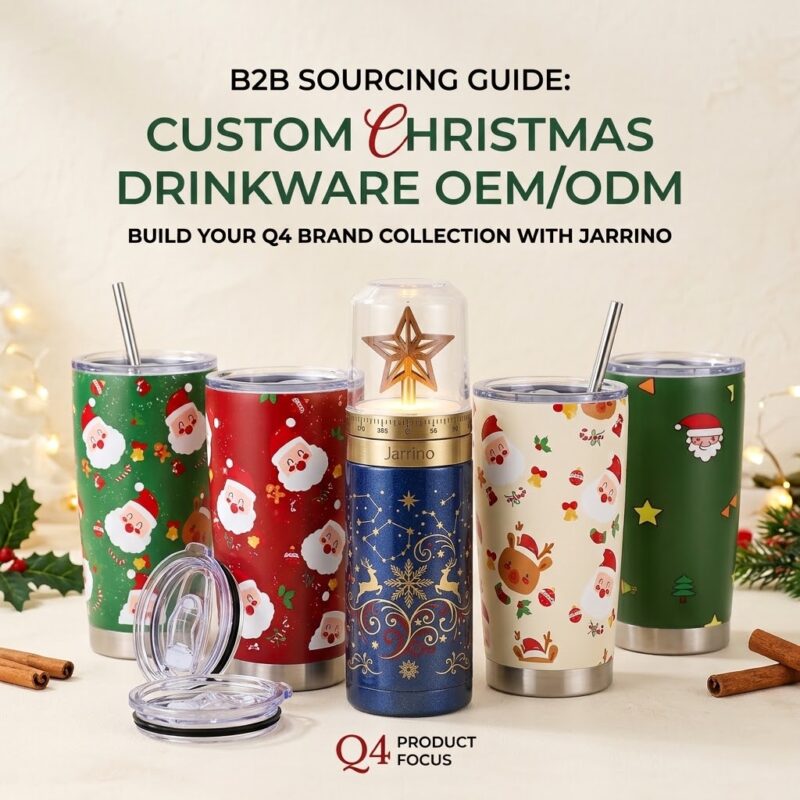
Jarrino is a certified OEM/ODM manufacturer specializing in custom vacuum flasks, ceramic-lined tumblers, and titanium drinkware. Lead times for Q4 custom Christmas orders are 20–30 days with low MOQs (300–1,000 pcs) and full FDA/LFGB compliance. We offer end-to-end customization including 3D digital printing, 레이저 조각, and bespoke Christmas gift packaging. Sample kits and the quotes are available upon request to help brands lock in Q4 holiday production smoothly.
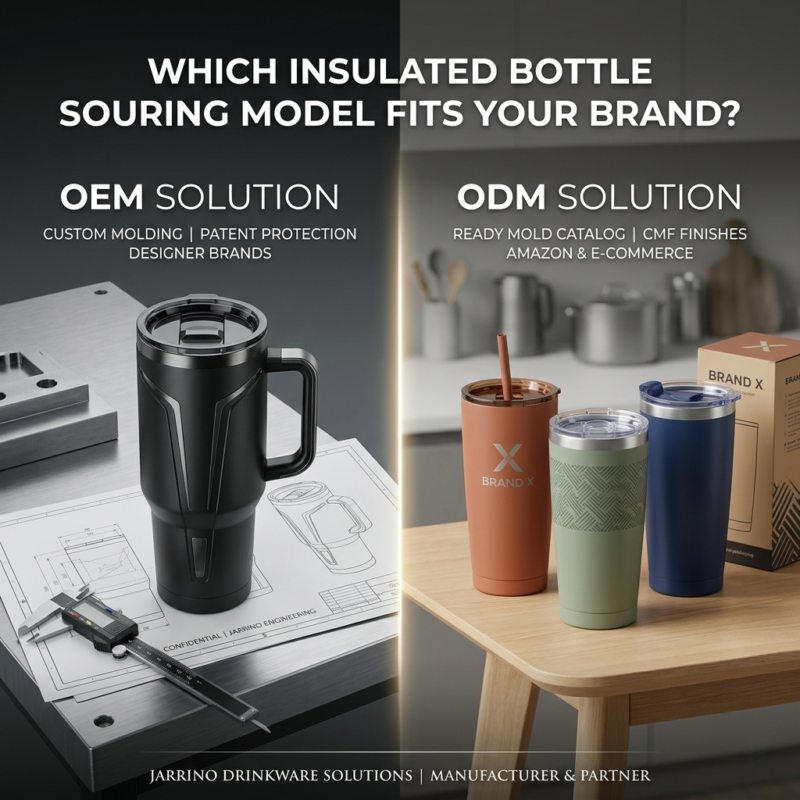
OEM 중에서 선택 (OEM 제조) 그리고 ODM (독창적인 디자인 제조) 귀하의 음료 용기 브랜드의 R을 정의합니다&D 예산, 출시 시간, 그리고 제품 독점성. OEM은 맞춤형 CAD 설계와 고유한 IP 요구 사항을 갖춘 기존 브랜드에 이상적입니다., 헌금 100% 맞춤형 성형 및 특허 보호. ODM은 Amazon 판매자를 위해 만들어졌습니다., DTC 스타트업, 툴링 비용 제로를 추구하는 기업 구매자, 낮은 MOQ, 고급 CMF 마감을 통한 신속한 제품 출시 (분체 도장, UV 인쇄).
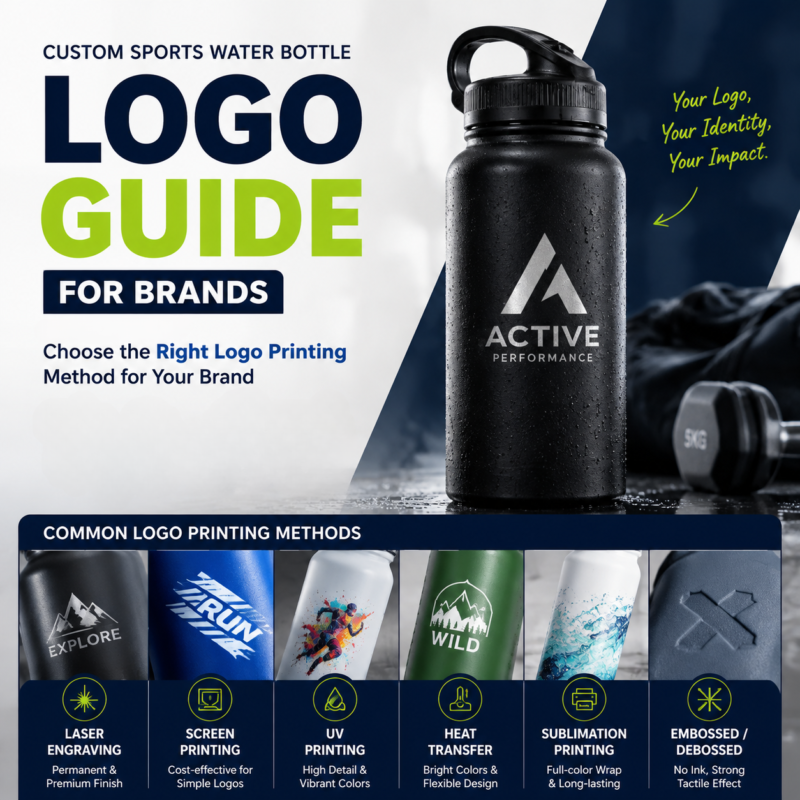
맞춤형 스포츠 물병 로고는 병 재질에 따라 다양한 장식 과정을 거쳐 제작됩니다., 브랜드 디자인, 및 성능 요구 사항. 이 가이드에서는 가장 일반적인 로고 인쇄 방법을 다룹니다., 레이저 각인을 포함해, 스크린 인쇄, UV 인쇄, 열 전달, 그리고 승화, 스포츠 브랜드가 내구성이 뛰어나고 전문적인 음료 용기 제품에 적합한 맞춤 옵션을 선택할 수 있도록 지원.
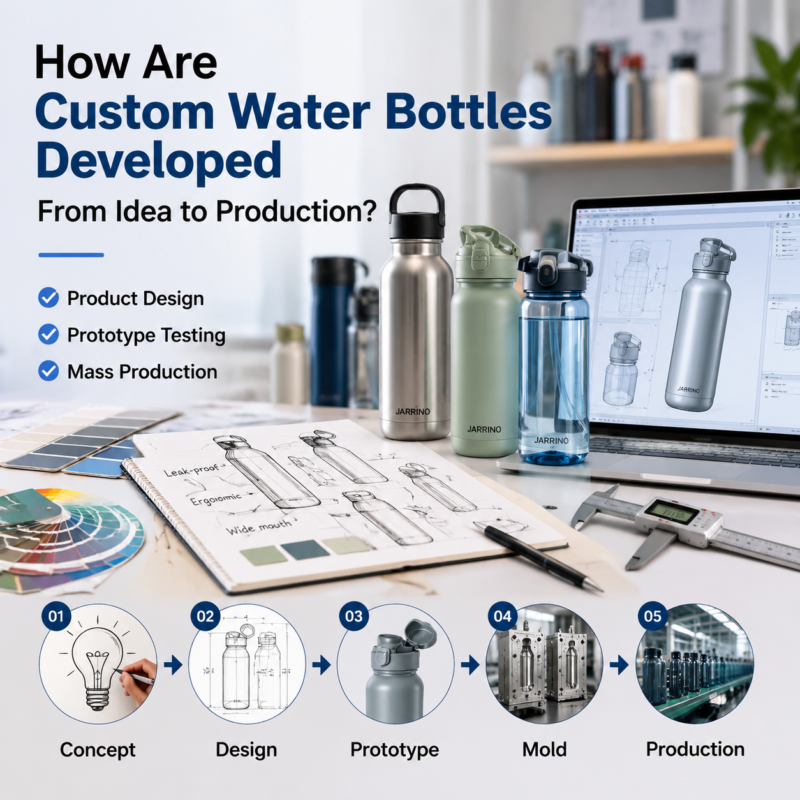
맞춤형 물병을 개발하려면 디자인을 선택하고 로고를 추가하는 것 이상이 필요합니다.. 초기 제품 컨셉부터 엔지니어링까지, 프로토타이핑, 금형 개발, 테스트, 그리고 대량생산, 모든 단계는 성공적인 음료 용기 제품을 만드는 데 중요한 역할을 합니다.. 이 가이드에서는 브랜드가 OEM 물병 제조업체와 협력하여 아이디어를 고품질로 전환하는 방법을 설명합니다., 시장에 바로 출시되는 제품과 디자인 관리, 비용, 그리고 생산 문제.
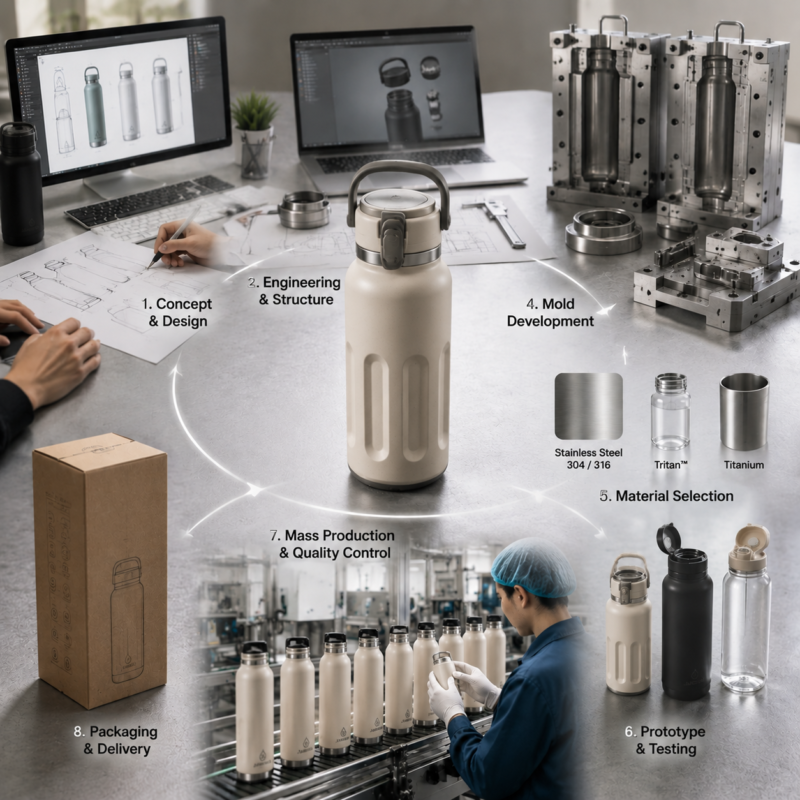
완전 맞춤형 물병을 개발하려면 기존 제품에 로고를 추가하는 것보다 훨씬 더 많은 것이 필요합니다.. 이 가이드에서는 브랜드가 제품 디자인을 통해 독특한 물병을 만드는 방법을 설명합니다., 공학, 재료 선택, 금형 개발, 프로토타입 테스트, 그리고 대량생산. 숙련된 OEM 물병 제조업체가 품질을 관리하면서 아이디어를 시장에 출시할 수 있는 제품으로 전환하는 데 어떻게 도움을 주는지 알아보세요., 비용, 생산 효율성.
맞춤형 물병 컬렉션의 성공은 매력적인 색상 그 이상에 달려 있습니다.. 올바른 색상 팔레트 선택, 표면 마무리, 제조 전략은 브랜드 아이덴티티 강화에 도움이 됩니다., 고객 매력 향상, 그리고 장기적인 판매를 보장합니다. 이 가이드에서는 시장 선호도에 따라 색상을 선택하는 방법을 설명합니다., 무광택 마감과 유광 마감 비교, SKU 최적화, 전문적인 OEM 생산을 통해 일관된 품질을 실현합니다..
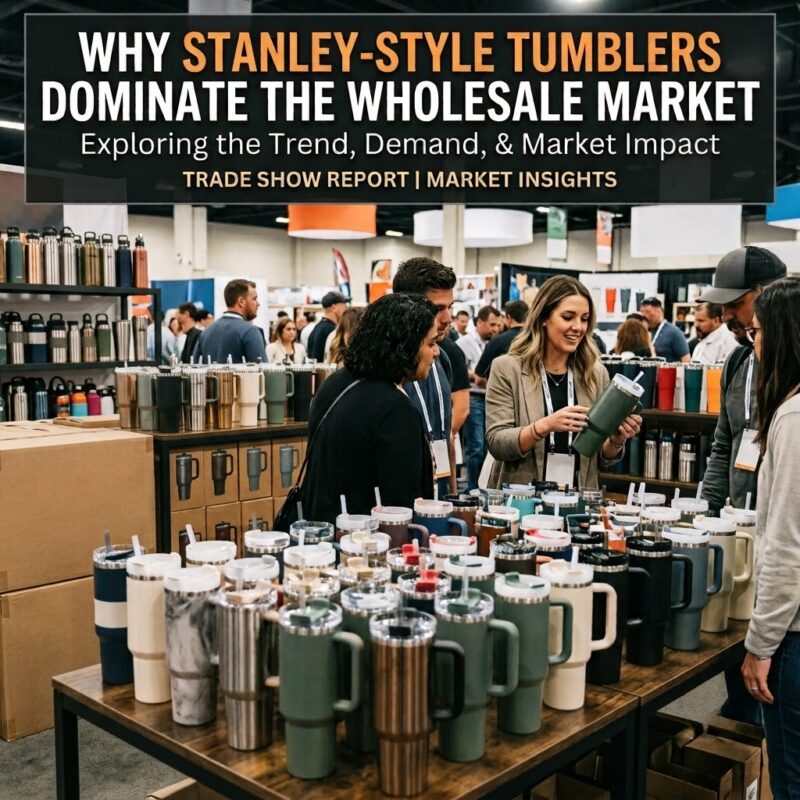
스탠리 스타일 텀블러는 문화 현상이자 도매 베스트셀러가 되었습니다.. 이 기사에서는 그 이유를 살펴봅니다. 18/8 높은 인식 가치를 제공하는 스테인리스 스틸 및 이중벽 진공 단열재, 맞춤화 가능성, 꾸준한 재주문 수요. 무엇이 이 텀블러를 믿을 수 있게 만드는지 알아보세요, 도매 구매자에게 유리한 카테고리.
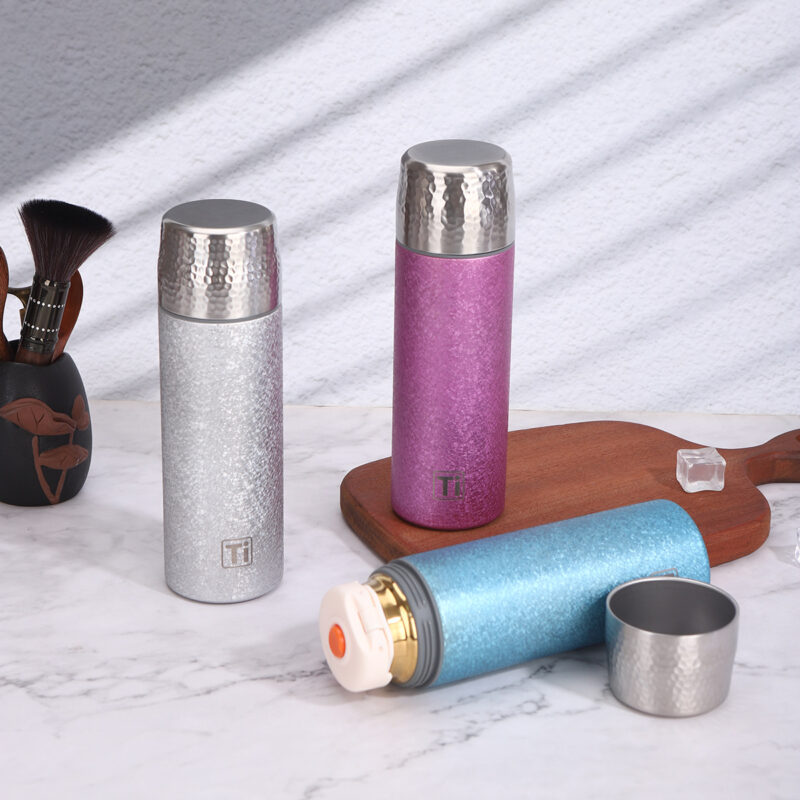
Titanium is safe. It’s also expensive. Here’s how it stacks up against stainless steel and aluminum – and which material actually makes sense for your brand.
Learn how the EU Microplastics Regulation (EU) 2026/1168 impacts custom water bottle manufacturers and private label drinkware brands. Discover how Jarrino helps importers stay REACH compliant with durable stainless steel water bottles.
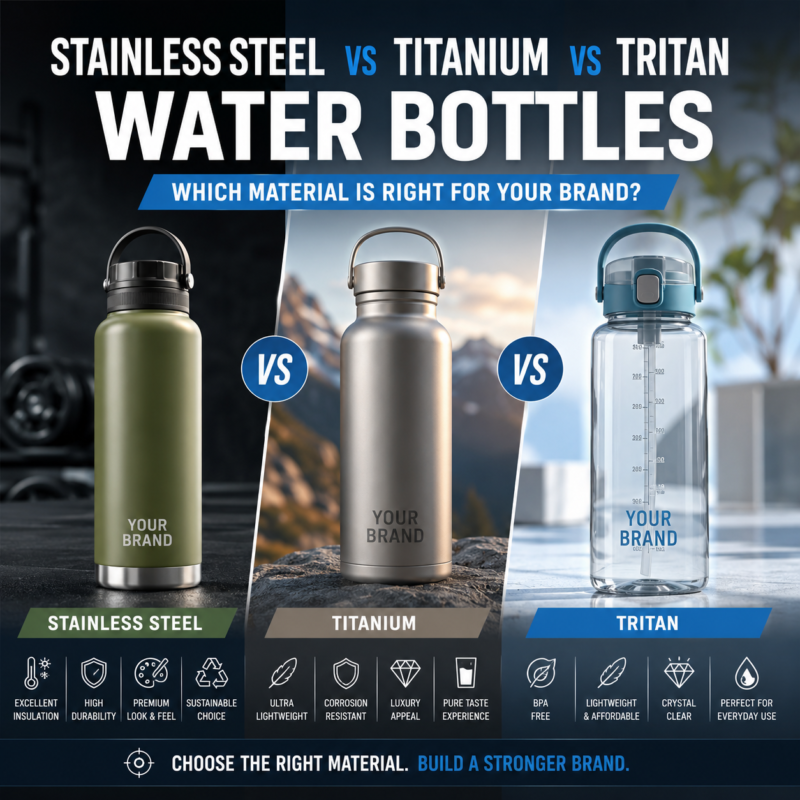
Choosing the right water bottle material can significantly impact your product quality, pricing, and brand positioning. This guide compares stainless steel, 티탄, and Tritan water bottles across durability, 격리, 비용, customization, and sustainability to help brands, 소매점, and OEM buyers select the best material for their target market.
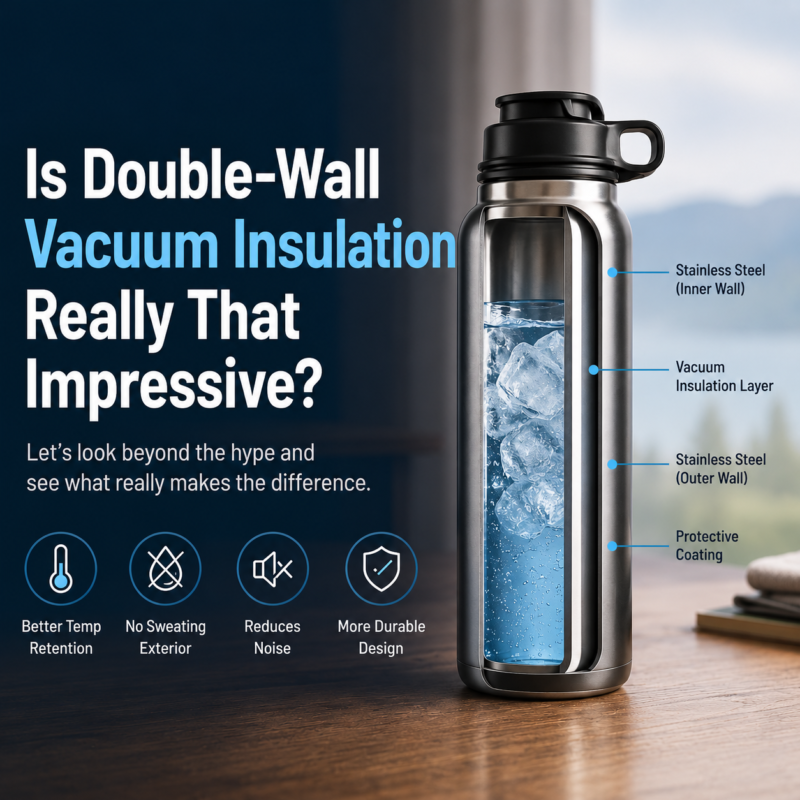
Double‑wall vacuum insulation is standard in premium drinkware, but the difference between a bottle that performs and one that disappoints comes down to manufacturing quality. This guide explains how vacuum insulation works, sets realistic performance expectations, and gives B2B buyers a practical checklist for evaluating suppliers. Plus, why Jarrino’s strict quality standards ensure your custom bottles deliver on their promises.
Not every water bottle fits every B2B use case. This article matches three materials — stainless steel, 알류미늄, plastic — to real‑world applications: gyms, corporate gift boxes, trade shows, outdoor retail, and school programs. Stainless steel wins on durability and insulation. Aluminum offers lightweight, full‑color branding. Plastic is budget‑friendly for high‑volume events (provided it’s BPA‑free). A quick cheat sheet helps B2B buyers balance cost, brand image, and user expectations.
최고의 경험을 제공하기 위해, 당사는 장치 정보를 저장 및/또는 액세스하기 위해 쿠키와 같은 기술을 사용합니다.. 이러한 기술에 동의하면 당사는 이 사이트의 탐색 행동이나 고유 ID와 같은 데이터를 처리할 수 있습니다.. 동의하지 않거나 동의를 철회하는 경우, 특정 특징 및 기능에 부정적인 영향을 미칠 수 있습니다..
기능성
항상 활성
가입자 또는 사용자가 명시적으로 요청한 특정 서비스의 이용을 가능하게 하는 적법한 목적을 위해 기술적 저장 또는 접근이 반드시 필요한 경우, 또는 전자 통신 네트워크를 통해 통신을 전송하기 위한 목적으로만 사용됩니다..
환경설정
가입자나 이용자가 요청하지 않은 기본 설정을 저장하는 적법한 목적을 위해 기술적 저장이나 접근이 필요한 경우.
통계
통계 목적으로만 사용되는 기술적 저장 또는 액세스.익명 통계 목적으로만 사용되는 기술적 저장 또는 액세스. 소환장 없이, 인터넷 서비스 제공업체의 자발적인 준수, 또는 제3자의 추가 기록, 이러한 목적으로 저장되거나 검색된 정보만으로는 일반적으로 귀하를 식별하는 데 사용할 수 없습니다..
마케팅
광고 전송을 위한 사용자 프로필 생성을 위해 기술적 저장 또는 접근권한이 필요합니다., 또는 유사한 마케팅 목적으로 웹사이트나 여러 웹사이트에서 사용자를 추적하기 위해.