
Reglamento de microplásticos de la UE 2026: Lo que todo fabricante de botellas de agua personalizadas debe saber
The European Union continues to strengthen environmental regulations, and the latest update to its microplastics legislation is another important milestone for manufacturers, importers, and private label brands.
On June 1, 2026, the European Commission adopted Regulation (UE) 2026/1168, further amending the existing restrictions on intentionally added synthetic polymer microparticles under REACH Annex XVII Entry 78. While the amendment primarily clarifies several exemptions introduced by Regulation (UE) 2023/2055, it also introduces an important change that will directly affect many consumer products, including drinkware with polymer-based coatings and finishes.
If you’re sourcing products from a custom water bottle manufacturer or planning to launch your own drinkware brand in Europe, understanding these regulatory updates is essential. Compliance is no longer simply a legal requirement—it has become a competitive advantage that influences retailer approvals, customs clearance, brand reputation, and long-term market access.
As a professional stainless steel water bottle manufacturer, Jarrino closely follows international regulations and continuously updates our production processes to ensure every product meets the latest compliance requirements for global markets.
Key Takeaways
Looking for a reliable manufacturing partner? Explore our OEM Water Bottle Manufacturing services.
- Regulation (UE) 2026/1168 further clarifies existing REACH restrictions on intentionally added microplastics.
- The revised «solid matrix» exemption will become stricter from June 22, 2028.
- Importers should review coatings, acabados, and polymer-containing components used in drinkware products.
- Working with a reliable water bottle manufacturer that provides complete REACH documentation can significantly reduce compliance risks.
- Stainless steel reusable bottles remain one of the most sustainable and regulation-friendly drinkware solutions for European markets.
What Is the EU Microplastics Regulation
Microplastics are generally defined as solid synthetic polymer particles smaller than five millimeters that are insoluble and resistant to degradation. Scientific studies have identified microplastics in oceans, rivers, soil, food, drinking water, and even the human body, leading regulators worldwide to introduce stricter controls on their intentional use.
To reduce environmental pollution, the European Union introduced Regulation (UE) 2023/2055, adding Entry 78 to REACH Annex XVII. The regulation restricts the placing on the market of intentionally added synthetic polymer microparticles, either on their own or in mixtures, above specified concentration limits.
The newly adopted Regulation (UE) 2026/1168 does not replace the previous regulation. Instead, it refines several provisions, clarifies exemptions, and provides additional guidance to ensure consistent implementation across EU member states.
For companies sourcing products from a custom water bottle manufacturer, these updates reinforce the importance of selecting suppliers that understand international compliance requirements and maintain transparent material documentation.
What Changed Under Regulation (UE) 2026/1168?
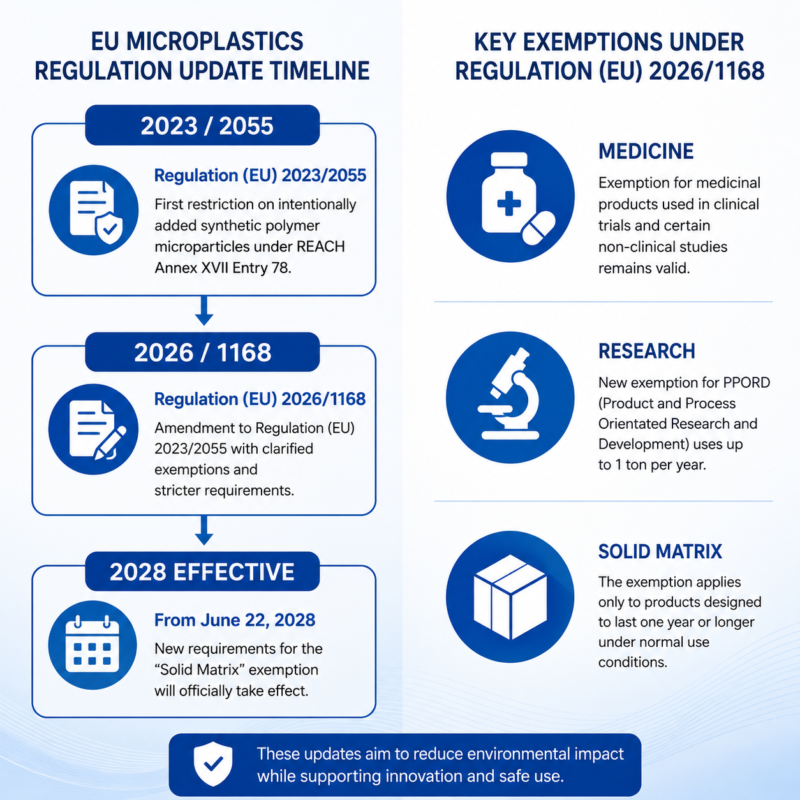
The latest amendment focuses on three key areas.
1. Clarification for Medicinal Products
The regulation now clearly confirms that medicinal products used in clinical trials and certain pre-clinical research remain exempt from the restrictions. This clarification mainly affects pharmaceutical manufacturers and has little direct impact on the drinkware industry.
2. New PPORD Research Exemption
A new exemption applies to Product and Process Orientated Research and Development (PPORD) activities involving synthetic polymer microparticles in quantities of one tonne or less per year.
This exemption supports scientific innovation while maintaining strict controls over commercial applications.
3. Revised «Solid Matrix» Exemption
This is the amendment that matters most for manufacturers of consumer products.
Previously, synthetic polymer microparticles permanently incorporated into a solid matrix during intended end use could qualify for an exemption.
The updated regulation now specifies that this exemption only applies when the intended end use lasts one year or longer.
This clarification will officially apply from June 22, 2028, giving manufacturers and supply chains a two-year transition period to review affected products.
For reusable stainless steel drinkware, this change generally supports long-life product design. Sin embargo, promotional items, short-life products, or products relying on polymer-rich decorative finishes may require additional compliance reviews.
Why Should Water Bottle Manufacturers Pay Attention?
Many buyers assume that stainless steel bottles are automatically unaffected by microplastics legislation.
In reality, regulators evaluate the entire product, not just the bottle body.
Potential areas requiring review include:
- Powder coatings
- Decorative surface finishes
- Plastic accessories
- Silicone seals
- Printed coatings
- Polymer-based decorative films
- Certain packaging materials
Although high-quality stainless steel itself does not contain intentionally added microplastics, manufacturers still need to verify that every component complies with REACH requirements.
This is why choosing an experienced fabricante de botellas de agua de acero inoxidable is becoming increasingly important for European importers.
Rather than simply supplying products, a professional manufacturing partner should also provide technical documentation, material declarations, compliance certificates, and supply chain transparency.
How Does This Affect Private Label Water Bottle Brands?
If you operate an Amazon brand, retail chain, promotional products company, corporate gifting business, or sports drinkware brand, the regulation creates both responsibilities and opportunities.
Importers are increasingly expected to understand the materials used throughout their products rather than relying solely on supplier assurances.
European retailers are also strengthening supplier qualification requirements by requesting documentation such as:
- REACH Declarations
- Material Safety Data Sheets (MSDS)
- Test Reports
- Material Composition Statements
- Factory Quality Certificates
- Supply Chain Traceability Records
Brands that can quickly provide these documents are more likely to pass supplier audits, avoid customs delays, and build long-term trust with distributors.
Conversely, businesses that cannot demonstrate compliance may face additional product reviews, delayed shipments, or increased sourcing costs as regulations continue to evolve.
For this reason, selecting a knowledgeable OEM water bottle manufacturer is no longer simply a purchasing decision—it has become part of a company’s broader risk management strategy.
Why Stainless Steel Remains the Preferred Choice
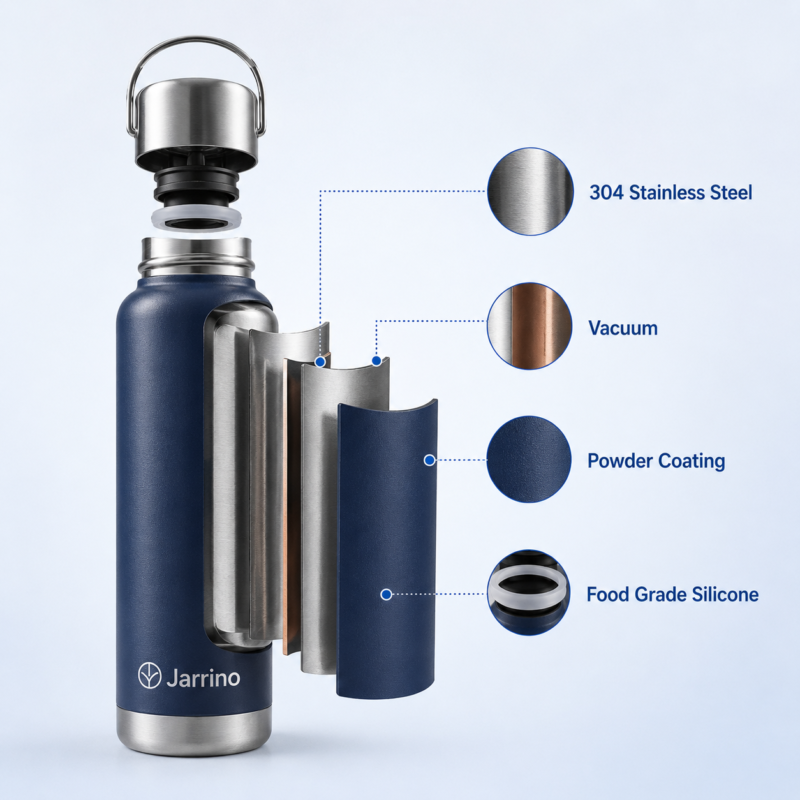
Among the most common drinkware materials—plastic, aluminio, vaso, and stainless steel—food-grade stainless steel continues to offer one of the strongest combinations of durability, recyclability, and regulatory compatibility.
Alta calidad 18/8 (304) stainless steel does not rely on intentionally added synthetic polymer microparticles for its structural performance. When combined with compliant coatings, food-grade silicone components, and properly controlled manufacturing processes, stainless steel bottles remain well positioned to meet evolving European sustainability expectations.
This is one of the reasons why many retailers, outdoor brands, fitness companies, and promotional product distributors are shifting toward reusable stainless steel drinkware as part of their long-term product strategy.
As a factory-direct water bottle manufacturer, Jarrino focuses on producing durable reusable drinkware designed for years of daily use, supporting both regulatory compliance and the growing demand for sustainable consumer products.
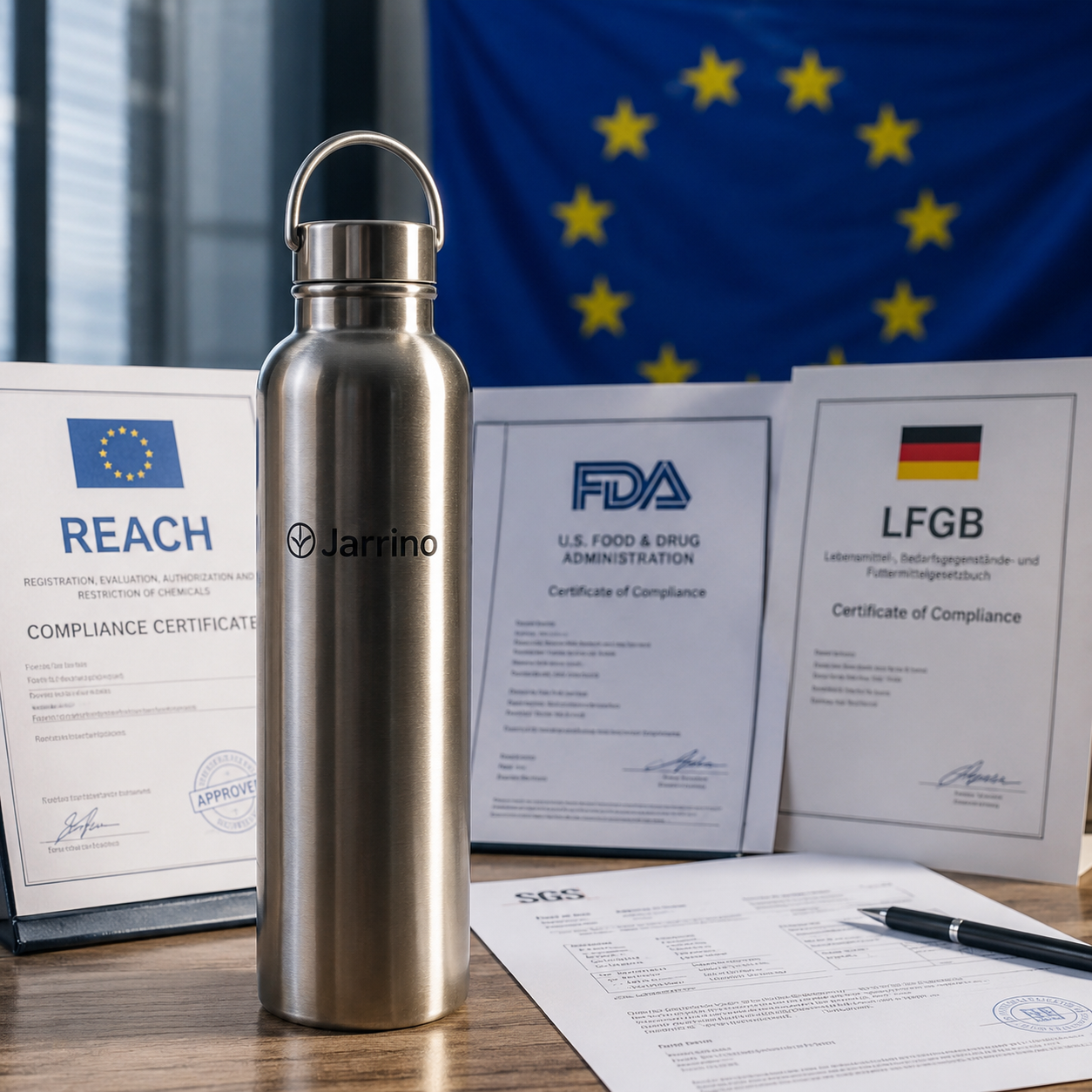
Why Jarrino Is a REACH-Compliant Water Bottle Manufacturer
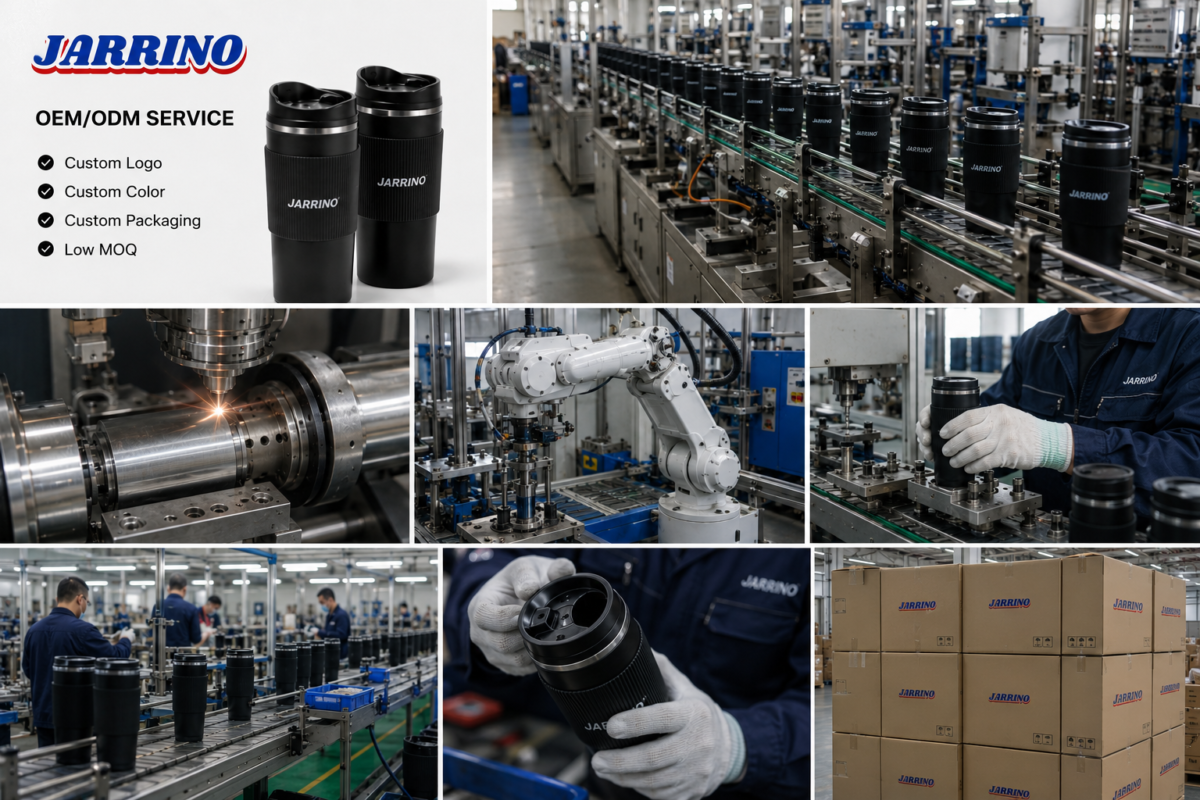
Choosing the right manufacturing partner has never been more important for brands selling into the European market. While product quality, pricing, and lead times remain important, regulatory compliance has become a key factor in supplier selection.
As a professional water bottle manufacturer, Jarrino integrates compliance into every stage of the manufacturing process—from raw material sourcing to finished product inspection—helping customers reduce regulatory risks while maintaining consistent product quality.
Rather than reacting to new regulations after they are introduced, we continuously monitor changes to international standards and update our sourcing and production practices accordingly.
Premium Food-Grade Stainless Steel
Every stainless steel bottle is manufactured using high-quality food-grade stainless steel, including 18/8 (304) y 316 acero inoxidable options for customers with higher corrosion resistance requirements.
Unlike many plastic products, stainless steel does not rely on intentionally added synthetic polymer microparticles for its structural performance. It is durable, reusable, recyclable, and designed for long-term use, making it an excellent choice for environmentally conscious brands.
Carefully Selected Coatings and Surface Treatments
Modern drinkware is expected to combine durability with attractive finishes. Powder coating, grabado con láser, impresión de pantalla de seda, impresión por transferencia de calor, impresión ultravioleta, and custom color finishes all play an important role in product customization.
En Jarrino, we work with qualified material suppliers and carefully evaluate coatings and decorative materials to ensure they comply with applicable REACH requirements. Whenever requested, we can provide supporting documentation for materials used during production.
Strict Quality Control Throughout Production
Compliance starts with quality manufacturing.
Every production batch follows a standardized quality control process, including:
- Incoming raw material inspection
- Stainless steel composition verification
- Surface finish inspection
- Vacuum insulation performance testing
- Leak testing
- Powder coating adhesion testing
- Packaging inspection before shipment
This systematic quality control process helps ensure consistent performance while reducing the risk of defects during international transportation.
Complete Compliance Documentation
One of the biggest challenges faced by importers is obtaining reliable documentation from suppliers.
Jarrino helps simplify this process by providing documentation such as:
- REACH Declaration
- Material Safety Data Sheets (MSDS)
- Food Contact Test Reports
- LFGB Test Reports (when applicable)
- FDA Compliance Reports (for U.S. markets)
- Material Certificates
- Factory Inspection Reports
- Product Specification Sheets
Having complete documentation available before shipment helps buyers prepare for customs clearance, retailer audits, and internal compliance reviews.
Compliance Documents Every Importer Should Request
Many buyers focus primarily on product pricing while overlooking compliance documentation until products arrive at customs.
This approach can create unnecessary delays, additional testing costs, and supply chain disruptions.
Before placing an order with any custom water bottle manufacturer, importers should request documentation covering both product safety and material compliance.
Important documents include:
REACH Declaration
Confirms that materials comply with relevant REACH restrictions applicable to the product.
Material Safety Data Sheets (MSDS)
Provide information regarding the chemical composition and safe handling of materials used during production.
Food Contact Test Reports
Verify that products intended for food and beverage use comply with applicable food contact requirements.
Material Certificates
Confirm the stainless steel grade used in production, such as SUS304 or SUS316.
Factory Audit Reports
Demonstrate that the manufacturer maintains appropriate quality management systems and production capabilities.
Product Testing Reports
Depending on destination markets, buyers may also require:
- LFGB Reports
- FDA Reports
- California Proposition 65 Reports
- Dishwasher Testing
- Salt Spray Testing
- Thermal Performance Testing
Working with an experienced OEM water bottle manufacturer makes obtaining these documents significantly easier.
How to Choose the Right Water Bottle Manufacturer for the European Market
Finding a supplier today involves much more than comparing quotations.
European buyers increasingly evaluate manufacturers based on compliance capability, production stability, sustainability practices, and documentation management.
When selecting a manufacturing partner, consider the following questions:
Does the factory understand European regulations?
A supplier should be familiar with REACH, food contact regulations, packaging requirements, and product testing standards.
Can the supplier provide compliance documents quickly?
Waiting weeks for documentation may delay product launches and retailer approvals.
Are raw materials traceable?
Material traceability helps demonstrate compliance throughout the supply chain.
Does the manufacturer offer customization?
Private label brands often require:
- Custom logos
- Powder coating
- Custom colors
- Grabado láser
- Gift packaging
- Retail packaging
- Barcode labeling
Choosing a factory that offers complete OEM and private label services can simplify project management.
Does the manufacturer have sufficient production capacity?
Reliable factories should be able to support both small trial orders and large wholesale production without compromising quality or delivery schedules.
Why Compliance Has Become a Competitive Advantage
Many businesses still view regulatory compliance as an unavoidable cost.
Forward-thinking brands see it differently.
Compliance creates trust.
Retail buyers increasingly prefer suppliers capable of providing complete documentation before products are shipped.
Consumers increasingly expect brands to demonstrate environmental responsibility.
Distributors want confidence that products can enter European markets without unexpected regulatory issues.
In other words, compliance has evolved from a legal requirement into a valuable marketing advantage.
Brands that invest early in compliant supply chains often experience:
- Faster customs clearance
- Improved retailer confidence
- Reduced regulatory risks
- Stronger brand reputation
- Greater customer loyalty
- Lower long-term compliance costs
Working with an experienced stainless steel water bottle manufacturer allows businesses to focus on growing their brands while minimizing regulatory uncertainty.
Sustainability and Long-Term Product Design
The revised EU microplastics regulation reflects a broader trend toward sustainable product design.
Rather than encouraging disposable consumer products, European regulations increasingly support products that are durable, reusable, repairable, and recyclable.
Reusable stainless steel water bottles align naturally with these objectives.
Compared with single-use drinkware, high-quality insulated stainless steel bottles can remain in daily use for many years.
This reduces waste generation, minimizes resource consumption, and supports circular economy initiatives promoted throughout Europe.
En Jarrino, sustainability extends beyond product materials.
We continuously improve manufacturing efficiency, reduce production waste, optimize packaging solutions, and work with responsible material suppliers to support more sustainable global supply chains.
For brands seeking long-term growth in Europe, choosing environmentally responsible products is no longer simply a trend—it is becoming a business necessity.
Frequently Asked Questions About the EU Microplastics Regulation
Does the EU microplastics regulation ban stainless steel water bottles?
No. The regulation does not ban stainless steel water bottles. Instead, it restricts intentionally added synthetic polymer microparticles used in certain products and materials. Food-grade stainless steel itself is not classified as a microplastic. Sin embargo, manufacturers should ensure that coatings, decorative finishes, plastic accessories, and other components also comply with applicable REACH requirements.
Are powder-coated water bottles REACH compliant?
They can be. Compliance depends on the formulation of the coating materials and whether they contain intentionally added synthetic polymer microparticles that fall within the scope of the regulation. Working with a qualified water bottle manufacturer that sources compliant coating materials and provides REACH documentation is essential.
Will the regulation affect private label drinkware brands?
Sí. Private label brands importing products into the European Union are responsible for ensuring that their products meet applicable regulatory requirements. Buyers should request compliance documentation from their manufacturers and verify that all materials used in production satisfy current REACH restrictions.
What documents should I request from my water bottle manufacturer?
Before placing an order, importers should ask for:
- REACH Declaration
- Material Certificates
- Food Contact Test Reports
- Material Safety Data Sheets (MSDS)
- Factory Audit Reports
- Product Test Reports
- Quality Inspection Reports
Having these documents available before shipment helps reduce customs delays and retailer compliance issues.
Why choose stainless steel over plastic drinkware?
Stainless steel offers excellent durability, resistencia a la corrosión, and long service life. Unlike disposable plastic bottles, reusable stainless steel drinkware supports sustainability goals, reduces waste, and aligns with growing consumer demand for environmentally responsible products.
Why Global Brands Choose Jarrino
Finding a reliable manufacturing partner is about more than competitive pricing. It requires confidence in quality, compliance, production capacity, and long-term support.
As a factory-direct custom water bottle manufacturer, Jarrino has helped brands, distribuidores, mayoristas, promotional product companies, and retailers develop high-quality drinkware for customers around the world.
Our manufacturing capabilities include:
- Custom stainless steel water bottles
- Vacuum insulated tumblers
- Travel mugs
- Sports water bottles
- Coffee mugs
- Kids water bottles
- Promotional drinkware
- Corporate gift products
We also provide comprehensive OEM and private label services, including:
- Logo laser engraving
- Serigrafía
- impresión ultravioleta
- Powder coating
- Custom colors
- Custom packaging
- Retail packaging
- Gift box solutions
- Barcode labeling
- Product development support
Whether you are launching a new brand or expanding an existing product line, our experienced engineering, producción, and quality control teams work closely with you throughout the entire project.
Frequently Asked Questions
The EU Microplastics Regulation (UE) 2026/1168 does not ban stainless steel water bottles. Instead, it clarifies REACH restrictions on intentionally added synthetic polymer microparticles and tightens the «solid matrix» exemption for products intended to last less than one year. For brands sourcing custom drinkware, choosing a REACH-compliant water bottle manufacturer and maintaining complete compliance documentation are essential for accessing the European market.
1. Does the EU Microplastics Regulation affect stainless steel water bottles?
No. Food-grade stainless steel itself is not considered a microplastic and is not restricted under the EU Microplastics Regulation. Sin embargo, manufacturers should ensure that coatings, decorative finishes, plastic accessories, silicone seals, and other components comply with REACH requirements. Working with an experienced fabricante de botellas de agua de acero inoxidable helps minimize compliance risks.
2. What is Regulation (UE) 2026/1168?
Regulation (UE) 2026/1168 is an amendment to the EU’s REACH restrictions on intentionally added synthetic polymer microparticles. It clarifies several exemptions introduced by Regulation (UE) 2023/2055 and tightens the «solid matrix» exemption for products designed to last less than one year, with the new requirement taking effect on June 22, 2028.
3. Why are stainless steel water bottles considered more sustainable?
Reusable stainless steel water bottles are designed for long-term use, helping reduce single-use plastic waste. They are durable, recyclable, and support the European Union’s broader sustainability and circular economy objectives
4. How do I choose the right custom water bottle manufacturer?
When selecting a manufacturing partner, consider the following factors:
- Experience exporting to Europe
- ALCANZAR, LFGB, and FDA compliance
- OEM and private label capabilities
- Quality control system
- Production capacity
- Product customization options
- Complete technical documentation
- Reliable lead times
Choosing an experienced custom water bottle manufacturer helps ensure product quality, regulatory compliance, and a more stable supply chain.
5. Why choose Jarrino as your OEM water bottle manufacturer?
Jarrino specializes in custom stainless steel water bottles, zonas, Tazas de viaje, and insulated drinkware for wholesale and private label customers worldwide. We provide OEM & servicios ODM, strict quality control, REACH-compliant manufacturing, personalización flexible, and comprehensive documentation to help brands confidently serve the European and global markets
Conclusión
The EU Microplastics Regulation represents another important step toward reducing environmental pollution and encouraging more sustainable product design.
Although Regulation (UE) 2026/1168 primarily clarifies existing REACH restrictions, it also reinforces the importance of selecting manufacturing partners that understand evolving international regulations.
For importers, distribuidores, and private label brands, compliance should no longer be viewed as a last-minute requirement before shipment. Instead, it should become part of every sourcing decision.
Choosing an experienced fabricante de botellas de agua de acero inoxidable helps reduce regulatory risks, improve supply chain transparency, and strengthen customer confidence.
As environmental standards continue to evolve, businesses that invest in compliant, high-quality, and durable products will be better positioned for long-term success in the European market.
Partner with a Trusted Custom Water Bottle Manufacturer
En Jarrino, we combine manufacturing expertise with international compliance knowledge to help businesses build successful drinkware brands worldwide.
Whether you need custom insulated water bottles, zonas, Tazas de viaje, or private label drinkware, our experienced team is ready to support your business with reliable manufacturing, strict quality control, and complete documentation.
¿Por qué elegir Jarrino??
- Factory-direct pricing
- Professional OEM & servicios ODM
- Low MOQ starting from 200 piezas
- 15–25 working days production lead time
- ALCANZAR, LFGB, FDA, and BSCI compliant manufacturing
- Advanced customization options
- Global shipping support
- Dedicated project management
- Stable quality control system
- Responsive after-sales service
If you’re looking for a reliable water bottle manufacturer for the European market, Jarrino is ready to help you stay compliant while delivering premium products that meet your customers’ expectations.
Contact us today to request a quotation, catálogo de productos, or sample.
Correo electrónico: [email protected]
Publicaciones relacionadas
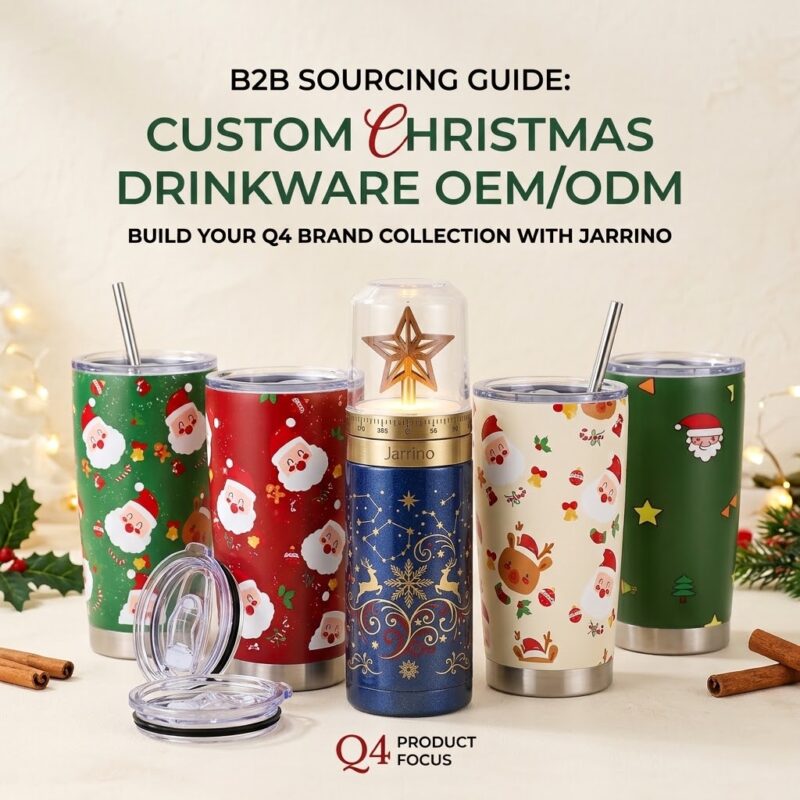
Vasos navideños personalizados: Guía completa de fabricación OEM/ODM
Jarrino es un fabricante certificado OEM/ODM que se especializa en matraces de vacío personalizados., vasos revestidos de cerámica, y vasos de titanio. Los plazos de entrega para los pedidos navideños personalizados del cuarto trimestre son de 20 a 30 días con MOQ bajos (300–1.000 unidades) y cumplimiento total de FDA/LFGB. Ofrecemos personalización de extremo a extremo, incluida la impresión digital 3D., grabado con láser, y embalaje de regalo de Navidad personalizado. Los kits de muestra y las cotizaciones están disponibles previa solicitud para ayudar a las marcas a asegurar la producción navideña del cuarto trimestre sin problemas..
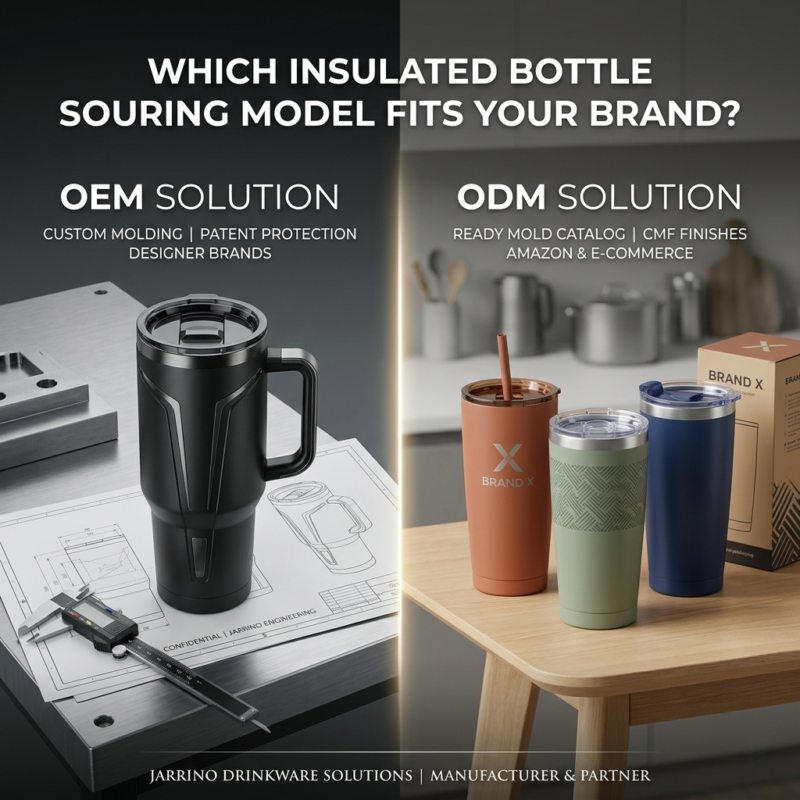
OEM frente a. Vasos aislados ODM: ¿Qué modelo de abastecimiento se adapta a su marca de vasos?
Elegir entre OEM (Fabricación de equipos originales) y ODM (Fabricación de diseño original) define la R de su marca de bebidas&presupuesto D, tiempo de comercialización, y exclusividad del producto. OEM es ideal para marcas establecidas con diseños CAD personalizados y requisitos de IP únicos, ofrenda 100% moldeado personalizado y protección de patentes. ODM está diseñado para vendedores de Amazon, Inicios de DTC, y compradores corporativos que buscan cero costos de herramientas, MOQ bajos, y lanzamientos rápidos de productos a través de acabados CMF avanzados (recubrimiento en polvo, impresión ultravioleta).
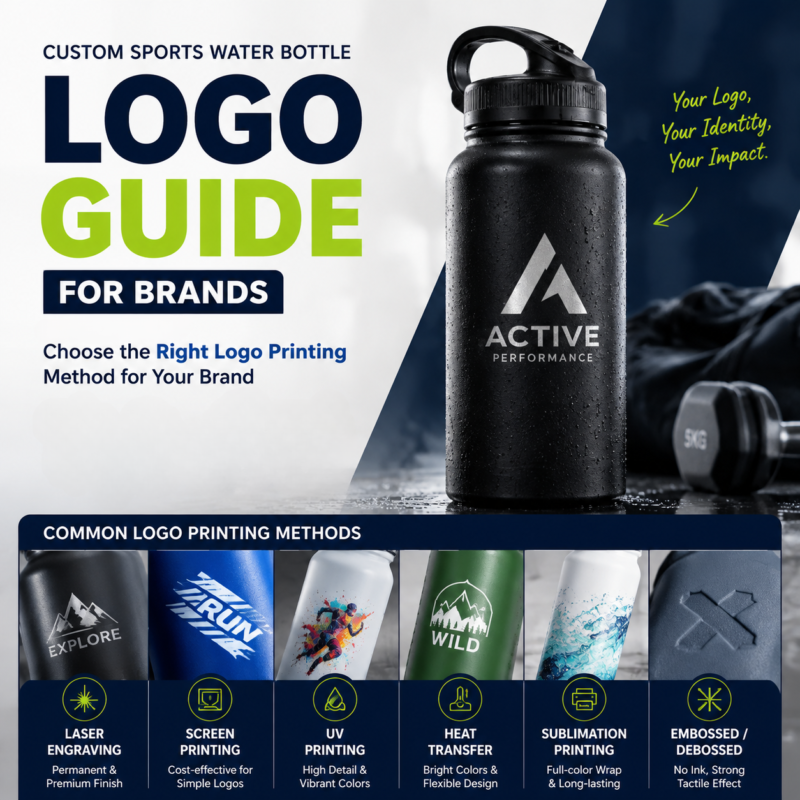
Guía de logotipos de botellas de agua deportivas personalizadas para marcas
Los logotipos personalizados de botellas de agua deportivas se crean mediante diferentes procesos de decoración según el material de la botella., diseño de marca, y requisitos de rendimiento. Esta guía cubre los métodos de impresión de logotipos más comunes., incluyendo grabado láser, serigrafía, impresión ultravioleta, transferencia de calor, y sublimación, Ayudar a las marcas deportivas a seleccionar la opción de personalización adecuada para productos de bebidas duraderos y profesionales..
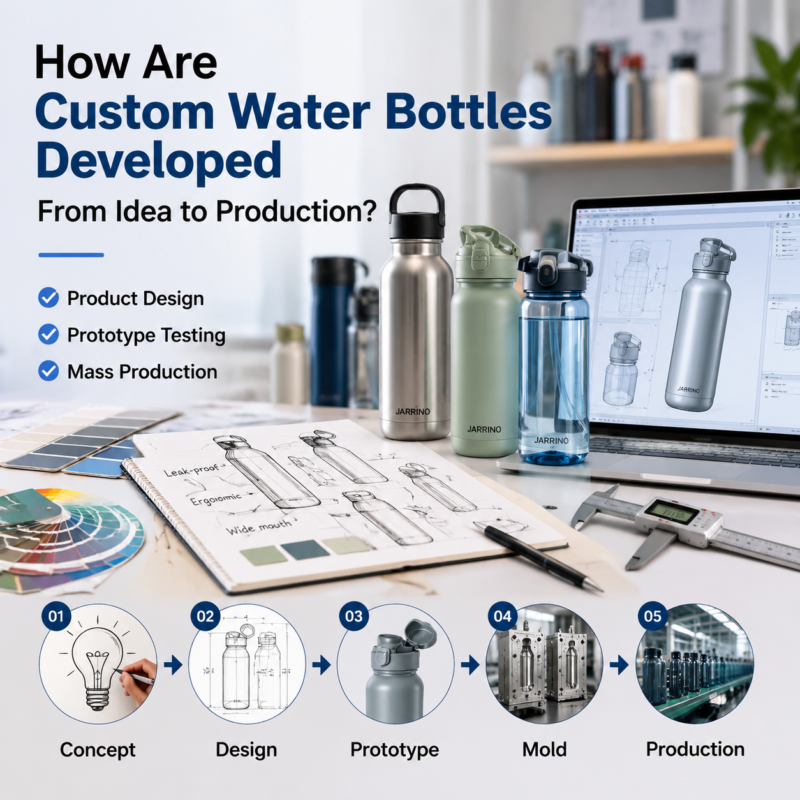
¿Cómo se desarrollan las botellas de agua personalizadas desde la idea hasta la producción??
Desarrollar una botella de agua personalizada requiere más que elegir un diseño y agregar un logotipo.. Desde el concepto inicial del producto hasta la ingeniería, creación de prototipos, desarrollo de moldes, pruebas, y producción en masa, Cada etapa juega un papel importante en la creación de un producto de bebida exitoso.. Esta guía explica cómo las marcas trabajan con los fabricantes de botellas de agua OEM para transformar ideas en alta calidad., Productos listos para el mercado mientras se gestiona el diseño., costo, y desafíos de producción.
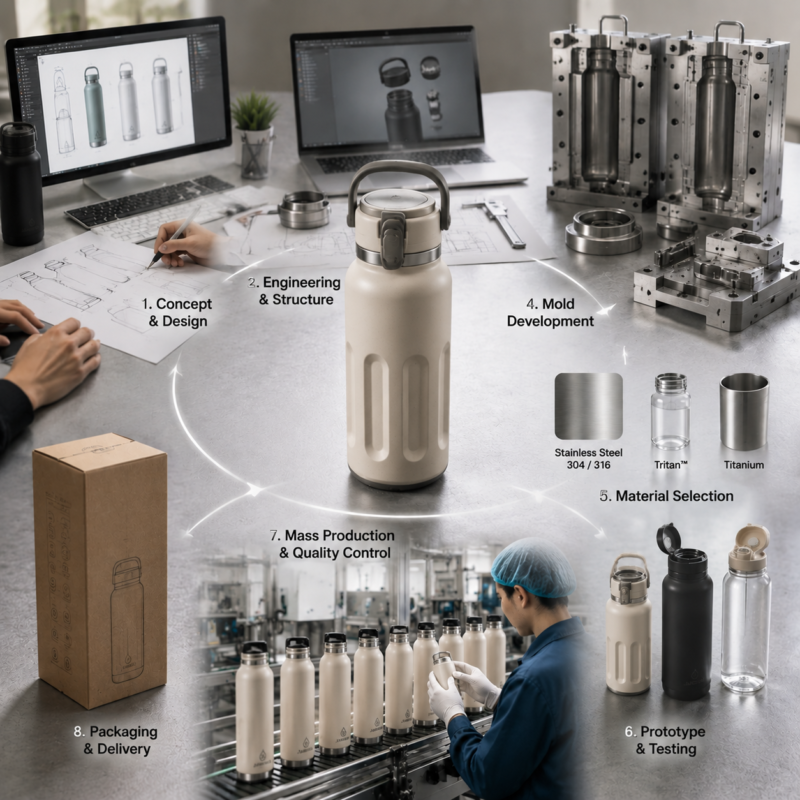
¿Cómo se fabrican las botellas de agua totalmente personalizadas??
Desarrollar una botella de agua totalmente personalizada implica mucho más que añadir un logotipo a un producto existente.. Esta guía explica cómo las marcas crean botellas de agua únicas a través del diseño de productos., ingeniería, selección de material, desarrollo de moldes, prueba de prototipo, y producción en masa. Descubra cómo un experimentado fabricante de botellas de agua OEM ayuda a transformar una idea en un producto listo para el mercado mientras gestiona la calidad., costo, y eficiencia de producción.
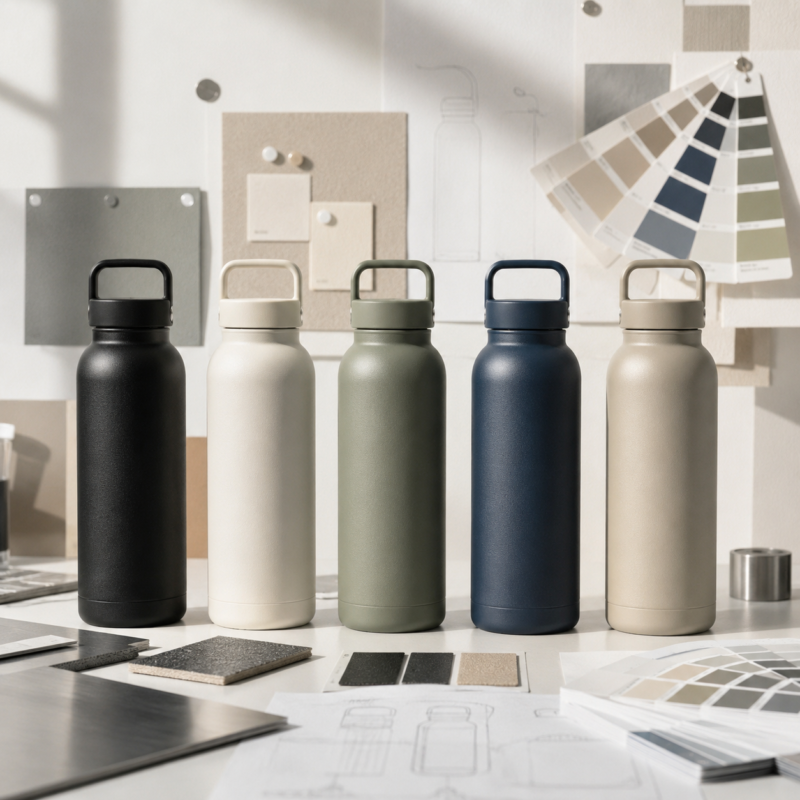
Cómo elegir colores y acabados para botellas de agua personalizadas
El éxito de una colección de botellas de agua personalizadas depende de algo más que colores atractivos. Elegir la paleta de colores adecuada, acabado superficial, y la estrategia de fabricación ayuda a fortalecer la identidad de la marca, mejorar el atractivo del cliente, y asegurar ventas a largo plazo. Esta guía explica cómo seleccionar colores según las preferencias del mercado., comparar acabados mate y brillante, optimizar los SKU, y lograr una calidad constante a través de la producción OEM profesional.
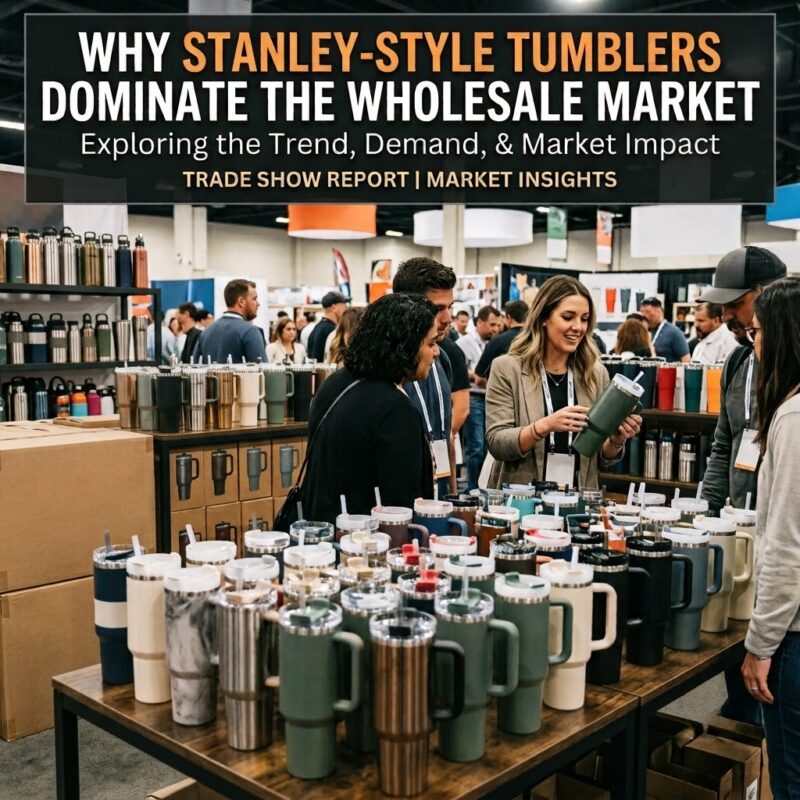
Por qué los vasos estilo Stanley dominan el mercado mayorista
Los vasos estilo Stanley se han convertido en un fenómeno cultural y un éxito de ventas al por mayor. Este artículo explora por qué – desde 18/8 Acero inoxidable y aislamiento al vacío de doble pared para un alto valor percibido., potencial de personalización, y demanda constante de pedidos repetidos. Descubra qué hace que estos vasos sean confiables, categoría rentable para compradores mayoristas.
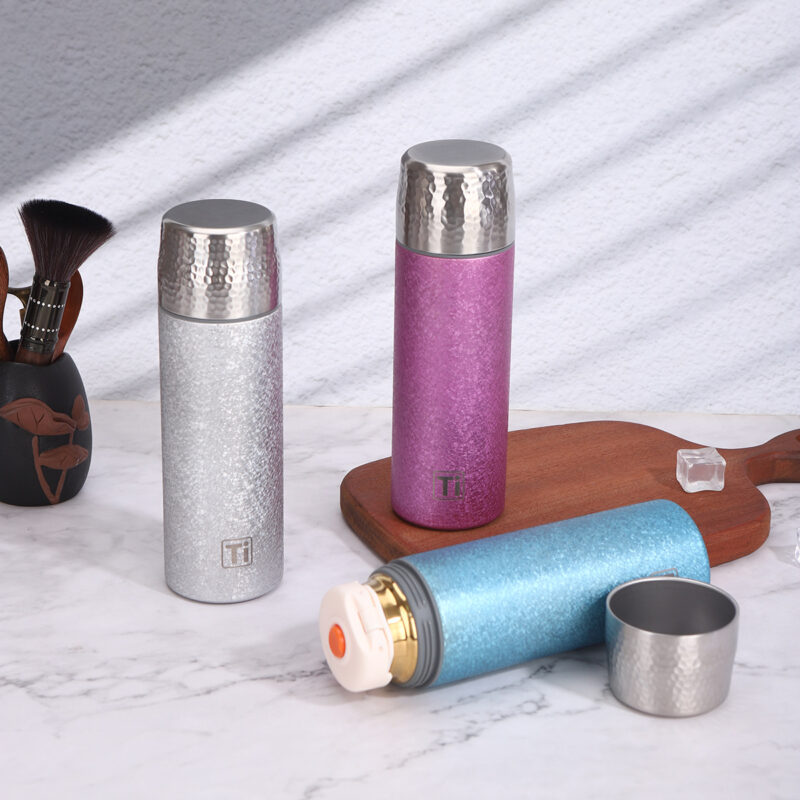
¿Son seguras las botellas de agua de titanio??
El titanio es seguro. También es caro. Así es como se compara con el acero inoxidable y el aluminio, y qué material realmente tiene sentido para su marca..
2026 Veranos más calurosos: ¿Crecerá la demanda de botellas de agua aisladas para los vendedores de consumo??
Será más caliente 2026 Los veranos en Europa y América del Norte aumentan la demanda de botellas de agua aisladas.? Descubra lo que Amazon, comprar, minorista, y los vendedores de marcas privadas deben prepararse para en 2026.
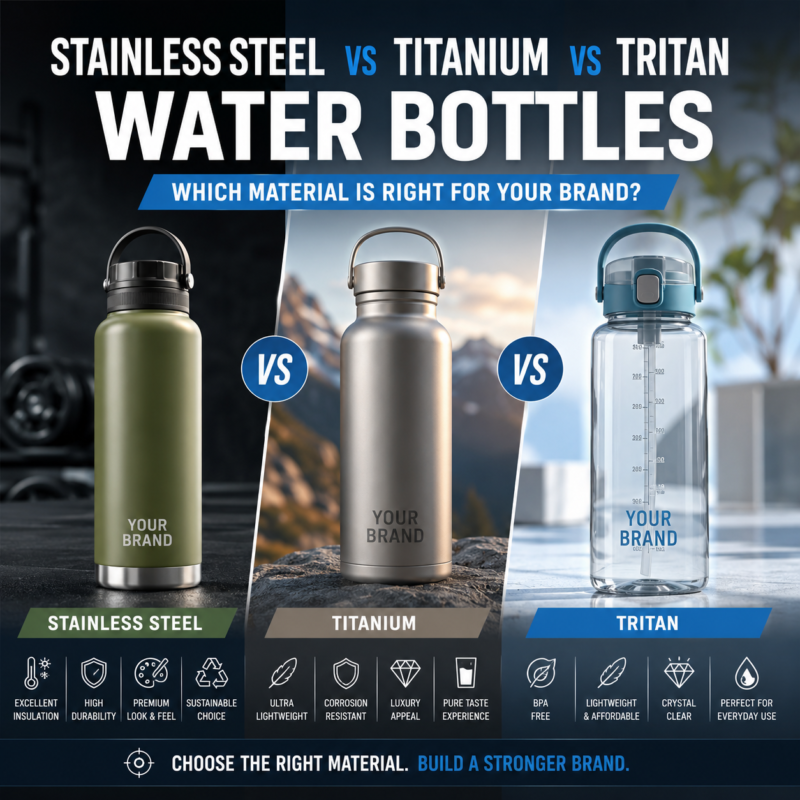
Stainless Steel vs Titanium vs Tritan Water Bottles: Which Material Is Right for Your Brand?
Choosing the right water bottle material can significantly impact your product quality, pricing, and brand positioning. This guide compares stainless steel, titanio, and Tritan water bottles across durability, aislamiento, costo, personalización, and sustainability to help brands, minoristas, and OEM buyers select the best material for their target market.
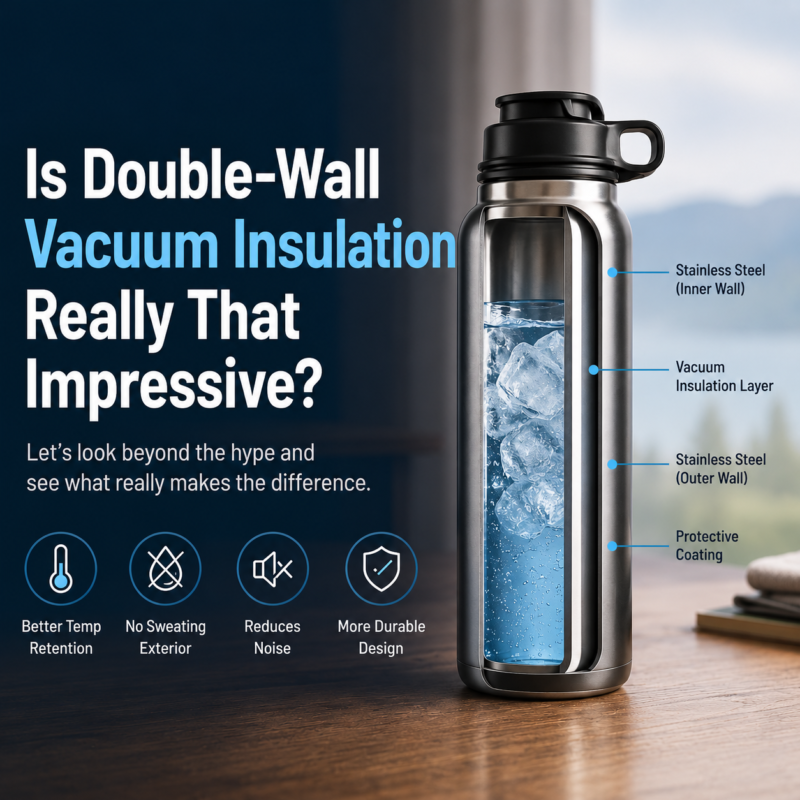
¿Es el aislamiento al vacío de doble pared realmente tan impresionante??
Double‑wall vacuum insulation is standard in premium drinkware, but the difference between a bottle that performs and one that disappoints comes down to manufacturing quality. This guide explains how vacuum insulation works, sets realistic performance expectations, and gives B2B buyers a practical checklist for evaluating suppliers. Plus, why Jarrino’s strict quality standards ensure your custom bottles deliver on their promises.
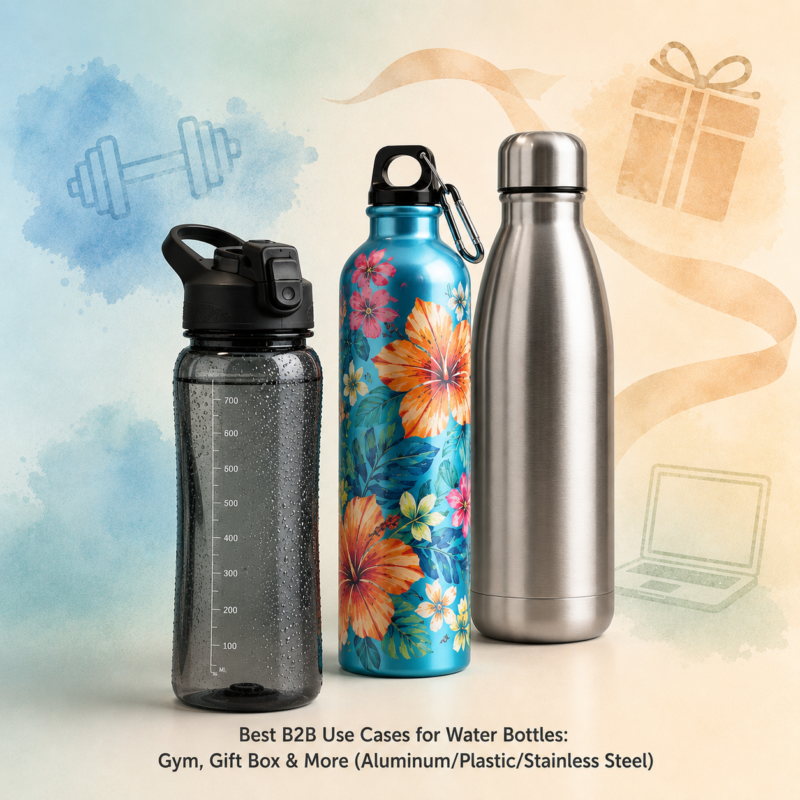
Los mejores casos de uso B2B para botellas de agua: Gimnasia, Caja de regalo & Más (Aluminio/Plástico/Acero)
No todas las botellas de agua se adaptan a todos los casos de uso B2B. Este artículo combina tres materiales: acero inoxidable., aluminio, plástico: a aplicaciones del mundo real: gimnasios, cajas de regalo corporativas, ferias comerciales, venta al por menor al aire libre, y programas escolares. El acero inoxidable gana en durabilidad y aislamiento. El aluminio ofrece ligereza, marca a todo color. El plástico es económico para eventos de gran volumen (siempre que esté libre de BPA). Una hoja de trucos rápida ayuda a los compradores B2B a equilibrar los costos, imagen de marca, y expectativas del usuario.