
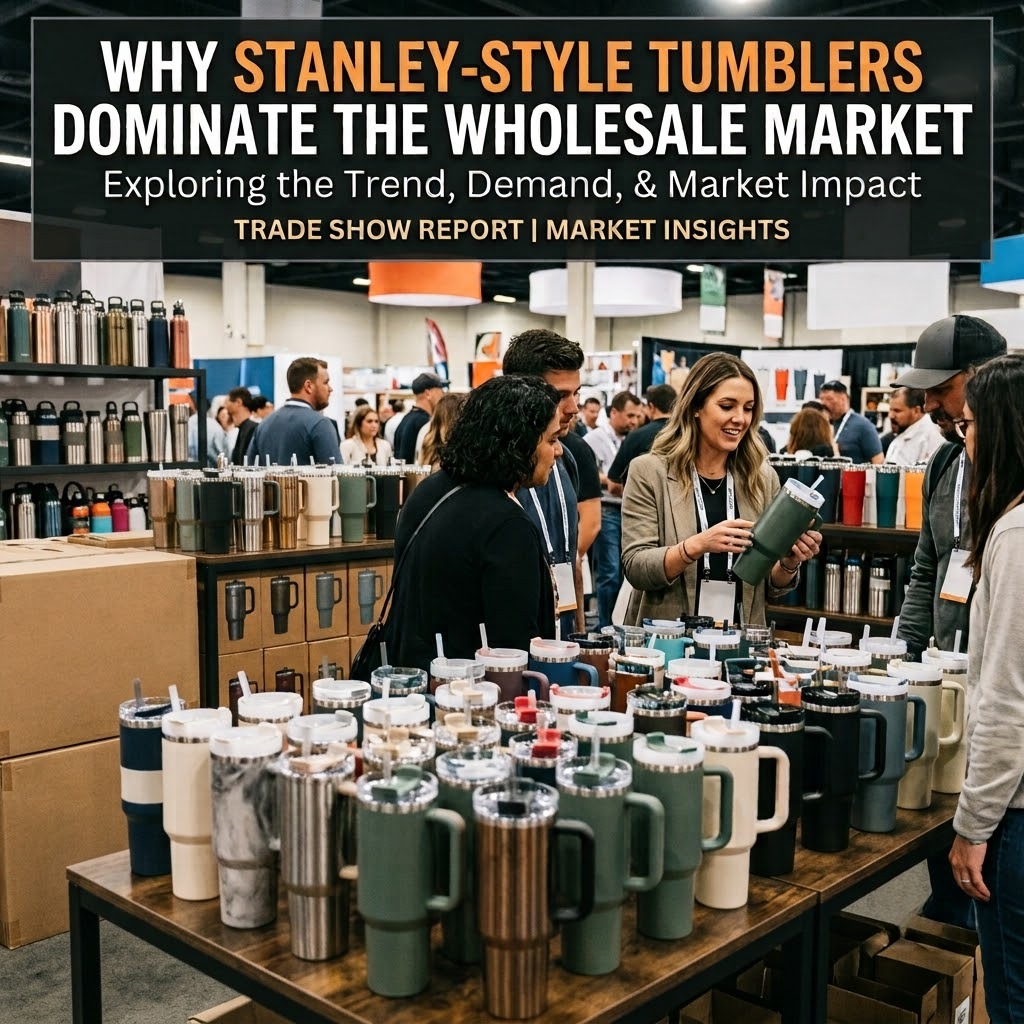
Warum Trinkgläser im Stanley-Stil den Großhandelsmarkt dominieren
Inhaltsverzeichnis
If you‘ve walked into any office, Fitnessstudio, or coffee shop in the past few years, you’ve seen them. Those rugged, powder‑coated stainless steel tumblers with the tapered silhouette and the unmistakable handle. They‘re everywhere — on desks, in car cup holders, clipped to backpacks, sitting next to laptops in conference rooms.
The Stanley‑style tumbler has become more than a drinkware trend. It’s a cultural phenomenon. And for wholesale buyers, it represents one of the most consistent, high‑demand product categories in the promotional products and retail drinkware space.
But why exactly do these tumblers dominate the wholesale market? And what does that mean for buyers looking to source them for their own brands, corporate gifting programs, or retail shelves?
Let‘s break it down.
The Product Itself: Built for Real Life
The Stanley‑style tumbler didn’t become popular by accident. It earned its place through a combination of thoughtful design, durable materials, and genuine utility.
18/8 Food‑Grade Stainless Steel
At the core of every quality Stanley‑style tumbler is 304 (18/8) Edelstahl. This material is food‑safe, rust‑resistant, and built to withstand daily abuse. Unlike plastic or glass alternatives, stainless steel doesn‘t retain flavors, doesn’t leach chemicals, and doesn‘t shatter when dropped.
For wholesale buyers, this means fewer returns, happier end users, and a product that actually lasts.
Double‑Wall Vacuum Insulation
The defining feature of these tumblers is their ability to keep drinks at the right temperature for hours. A well‑made Stanley‑style tumbler will keep coffee hot for 6‑8 hours and iced water cold for up to 24 Std..
This isn’t just a nice‑to‑have. It‘s the reason people carry these tumblers every day — and why they become attached to them. A product that becomes part of someone’s daily routine is a product that builds brand loyalty.
Leak‑Proof, Spill‑Resistant Design
From commuters to hikers to busy parents, people need drinkware that doesn‘t leak. The secure, leak‑proof lids on these tumblers give users the confidence to toss them in a bag without worrying about spills.
For corporate gift buyers, this reliability matters. A tumbler that leaks is a gift that gets thrown away. A tumbler that doesn’t is a gift that gets used every day.
Sizes That Work for Everyone
Stanley‑style tumblers come in a range of sizes — most commonly 20 oz, 30 oz, Und 40 oz. Each size serves a different purpose:
| Größe | Am besten für | Typical Use |
|---|---|---|
| 20 oz | Daily commuters, office workers, coffee drinkers | Fits most cup holders, leicht zu tragen, ideal for morning coffee |
| 30 oz | All‑day hydration, gym users, road trips | Large enough for a full workday, still fits standard cup holders |
| 40 oz | Outdoor enthusiasts, long shifts, heavy hydration | Maximum capacity, popular with tradespeople and outdoor workers |
This range allows wholesale buyers to stock a single product line that appeals to a wide cross‑section of end users.
The Stanley‑Style Effect
The Stanley brand itself has enjoyed a massive resurgence in recent years, driven by social media, influencer marketing, and viral content. But what wholesale buyers need to understand is that the demand is not limited to the Stanley brand itself.
Der Stil — the silhouette, the handle, the powder‑coated finish — has become the standard. Consumers recognize it. They trust it. And they expect it.
This means wholesale buyers don‘t need to sell the Stanley brand to succeed. They need to sell the Stanley‑style product — the same form factor, the same quality, the same utility — with their own branding.
And that’s where the wholesale opportunity truly opens up.
Why Wholesale Buyers Love This Category
For businesses sourcing drinkware for corporate gifts, promotional campaigns, or retail — the Stanley‑style tumbler offers several distinct advantages.
1. Broad Market Appeal
These tumblers appeal to just about everyone. Office workers. Outdoor enthusiasts. Parents. Students. Fitness buffs. Professionals. The demographic range is unusually wide for a single product category.
That means wholesale buyers can stock one product line and serve multiple customer segments. Less inventory complexity. Faster turnover.
2. High Perceived Value
A Stanley‑style tumbler feels premium. It‘s heavy. It’s solid. It looks like it costs more than it does. This makes it an ideal choice for corporate gifts, employee appreciation programs, and promotional campaigns where the goal is to impress.
When you hand someone a high‑quality tumbler, the message isn‘t “here’s a free thing.” The message is “we value you, and we value quality.”
3. Customization That Works
The large, flat surface of these tumblers makes them ideal for branding. Whether it‘s laser engraving, Siebdruck, or UV printing — a logo on a Stanley‑style tumbler gets seen. Daily. By the person carrying it and everyone they meet.
This is why promotional products distributors consistently rank drinkware among the most effective promotional items. The brand impression lasts for years, not days.
4. Strong Pricing and Margins
The wholesale cost of a high‑quality Stanley‑style tumbler typically falls between $3 Und $10 per unit, depending on customization level and order volume. Retail prices often range from $15 Zu $40.
For wholesale buyers, this leaves healthy margins — especially when ordering in volume. And with consistent demand, turnover is reliable.
5. Repeat Order Potential
A good tumbler doesn‘t break. But people lose them. They give them as gifts. They buy backups. And when they love a product, they buy more for friends and family.
For wholesale buyers, this translates to repeat orders. Customers who source from you once often come back for more.
6. Sustainability Credentials
Stainless steel is infinitely recyclable. It’s reusable. It reduces reliance on single‑use plastics. And in 2026, the focus on sustainability is stronger than ever. Brands and consumers alike are looking for products that align with environmental values.
A Stanley‑style tumbler fits that bill perfectly.
7. Stability in a Fast‑Changing Market
The global drinkware market is projected to grow from $36.81 billion in 2026 Zu $45.52 billion by 2030, at a CAGR of 5.5%. Insulated metal drinkware represents a significant and growing segment of this market.
Stanley‑style tumblers are not a flash‑in‑the‑pan trend. They’ve proven their staying power. Demand shows no sign of slowing. For wholesale buyers, this means stability — a product category that remains reliable year after year.
What Wholesale Buyers Should Look for in a Supplier
If you‘re ready to source Stanley‑style tumblers for your brand, the next step is finding the right manufacturing partner.
Material Transparency
A trustworthy supplier will openly state their material grade. Look for 304 Edelstahl and ask for material certifications. A supplier who can’t tell you what grade of steel they use is a supplier you should avoid.
Insulation Performance
Not all insulated tumblers perform equally. Ask for thermal test data. The best suppliers can provide real numbers on heat and cold retention — not just marketing claims.
Food‑Safety Compliance
If you‘re selling into the US or European markets, FDA and LFGB certifications are non‑negotiable. Make sure your supplier can provide current, valid compliance documentation.
Customization Capabilities
Can the supplier handle your logo requirements? Do they offer multiple printing methods? Can they match your brand colors? The right supplier makes customization easy, not complicated.
Consistent Quality Control
A great sample means nothing if the bulk order doesn’t match it. Look for suppliers with robust quality control processes — in‑process inspections, material traceability, and final product testing.
Reliable Lead Times
Know what to expect. A professional supplier will give you a clear timeline — sample development, Produktion, shipping, and customs. Surprises are acceptable in the mail, not in supply chains.
Communication
Suppliers who respond quickly to inquiries are more likely to resolve production issues quickly. Responsiveness matters.
Why Jarrino
Bei Jarrino, we manufacture premium Stanley‑style tumblers for wholesale buyers, corporate gift programs, and promotional product distributors. We use certified 304 stainless steel with full material traceability, LFGB and FDA compliance, and double‑wall vacuum insulation that delivers consistent temperature retention.
Our MOQ starts from 200 Stücke, with 15‑35 working days lead times for wholesale orders. Customization options include laser engraving, Siebdruck, color matching, und individuelle Verpackung. We ship to the USA, Europa, Australien, and beyond.
Contact Jarrino today to request a sample and discuss your wholesale order.
Related Posts
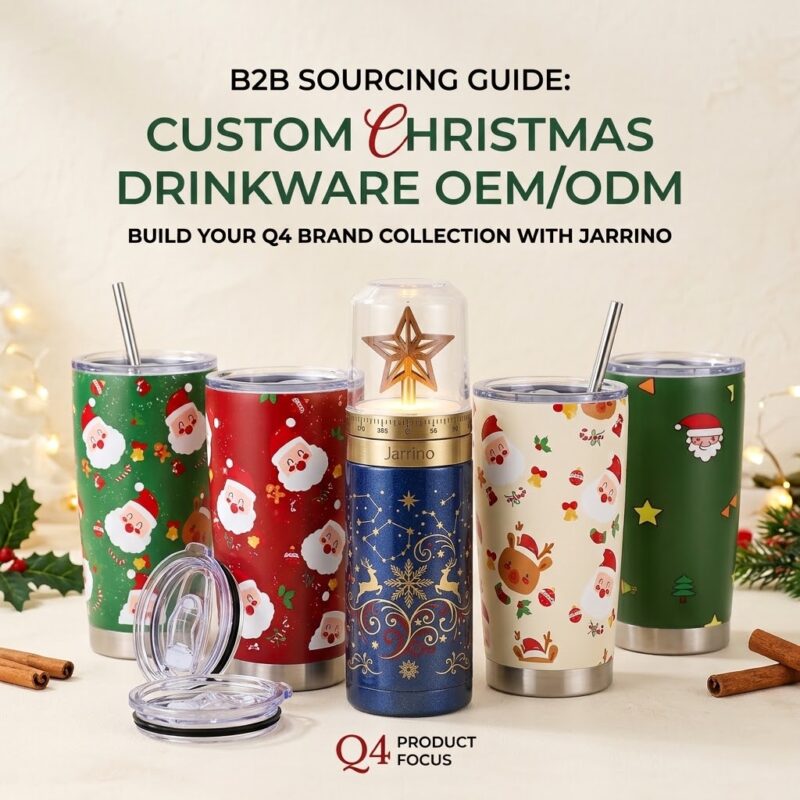
Custom Christmas Drinkware: Complete OEM/ODM Manufacturing Guide
Jarrino is a certified OEM/ODM manufacturer specializing in custom vacuum flasks, ceramic-lined tumblers, and titanium drinkware. Lead times for Q4 custom Christmas orders are 20–30 days with low MOQs (300–1,000 pcs) and full FDA/LFGB compliance. We offer end-to-end customization including 3D digital printing, Lasergravur, and bespoke Christmas gift packaging. Sample kits and the quotes are available upon request to help brands lock in Q4 holiday production smoothly.
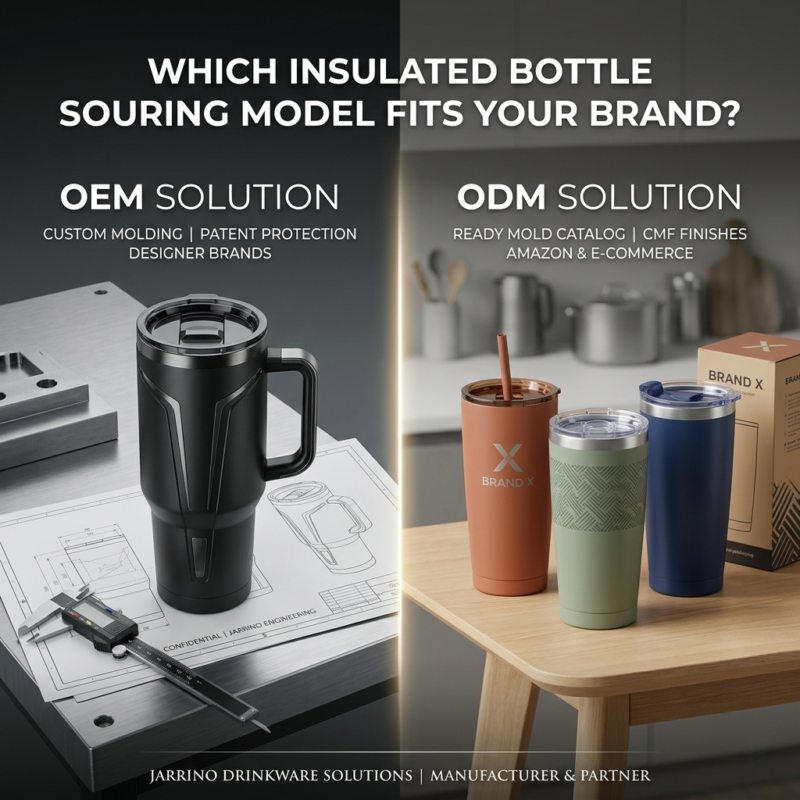
OEM vs. ODM-isolierte Becher: Welches Beschaffungsmodell passt zu Ihrer Getränkemarke?
Wahl zwischen OEM (Herstellung von Erstausrüstung) und ODM (Original-Design-Herstellung) definiert das R Ihrer Trinkgeschirrmarke&D-Budget, Time-to-Market, und Produktexklusivität. OEM ist ideal für etablierte Marken mit individuellen CAD-Designs und einzigartigen IP-Anforderungen, Angebot 100% kundenspezifisches Formen und Patentschutz. ODM wurde für Amazon-Verkäufer entwickelt, DTC-Startups, und Unternehmenskäufer, die keine Werkzeugkosten anstreben, niedrige MOQs, und schnelle Produkteinführungen durch fortschrittliche CMF-Oberflächen (Pulverbeschichtung, UV-Druck).
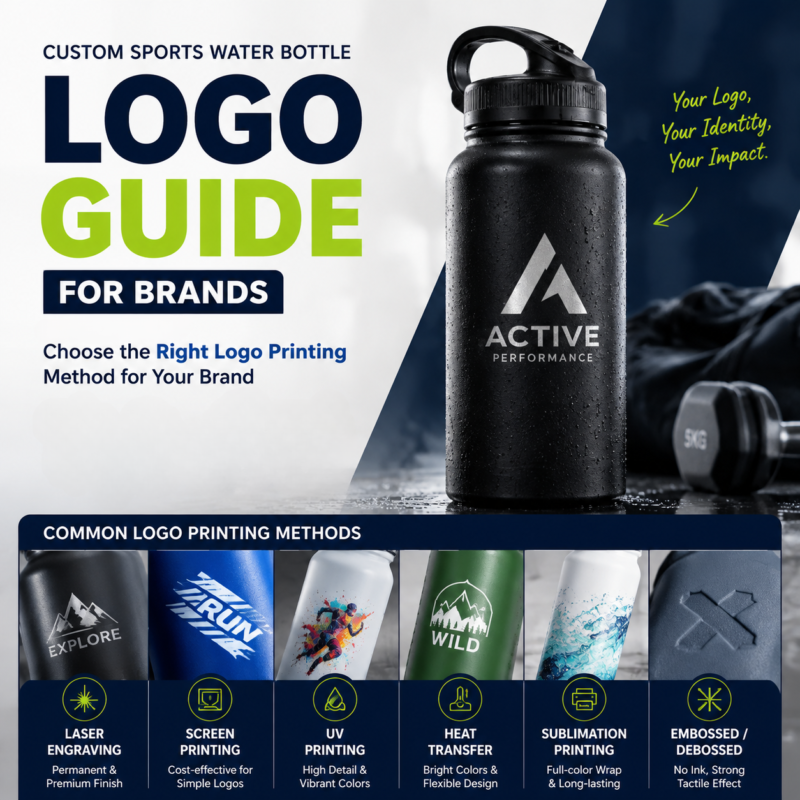
Leitfaden für individuelle Sportwasserflaschen-Logos für Marken
Individuelle Logos für Sportwasserflaschen werden je nach Flaschenmaterial durch unterschiedliche Dekorationsverfahren erstellt, Markendesign, und Leistungsanforderungen. In diesem Leitfaden werden die gängigsten Methoden zum Drucken von Logos behandelt, inklusive Lasergravur, Siebdruck, UV-Druck, Wärmeübertragung, und Sublimation, Unterstützung von Sportmarken bei der Auswahl der richtigen Individualisierungsoption für langlebige und professionelle Trinkgeschirrprodukte.
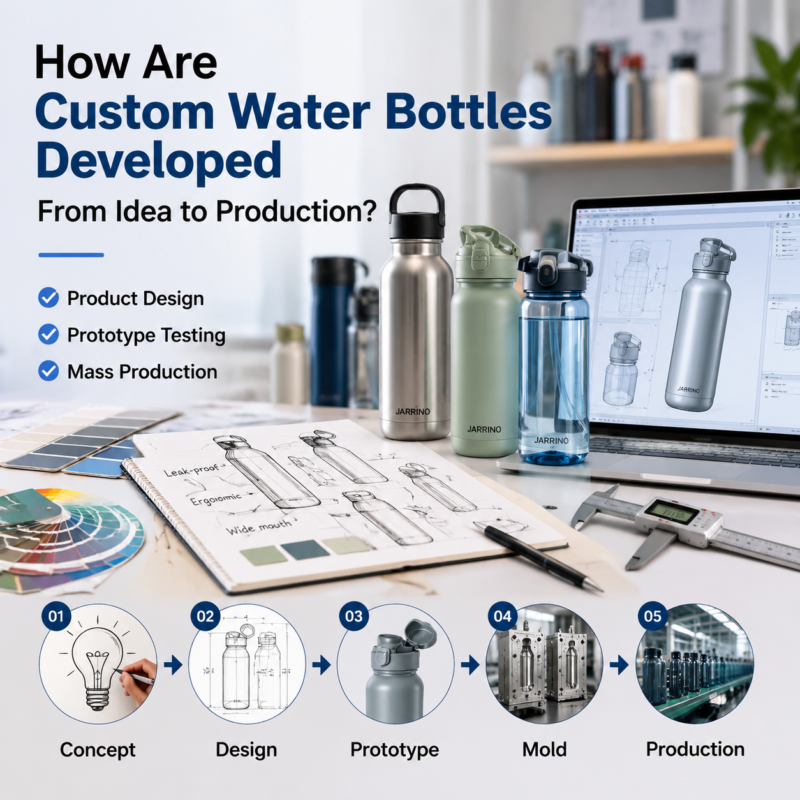
Wie werden maßgeschneiderte Wasserflaschen von der Idee bis zur Produktion entwickelt??
Die Entwicklung einer individuellen Wasserflasche erfordert mehr als nur die Auswahl eines Designs und das Hinzufügen eines Logos. Vom ersten Produktkonzept bis zum Engineering, Prototyping, Schimmelbildung, Testen, und Massenproduktion, Jede Phase spielt eine wichtige Rolle bei der Entwicklung eines erfolgreichen Trinkgeschirrprodukts. In diesem Leitfaden wird erläutert, wie Marken mit OEM-Wasserflaschenherstellern zusammenarbeiten, um Ideen in hochwertige Produkte umzusetzen, marktreife Produkte und managen gleichzeitig das Design, kosten, und Produktionsherausforderungen.
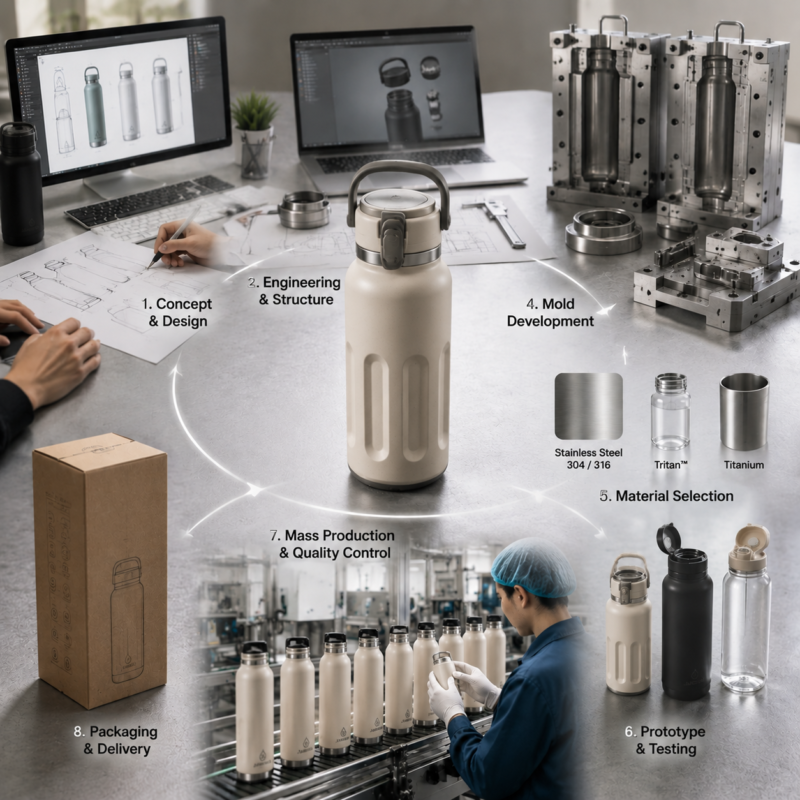
Wie werden vollständig maßgeschneiderte Wasserflaschen hergestellt??
Die Entwicklung einer vollständig maßgeschneiderten Wasserflasche erfordert viel mehr als nur das Hinzufügen eines Logos zu einem bestehenden Produkt. In diesem Leitfaden wird erklärt, wie Marken durch Produktdesign einzigartige Wasserflaschen schaffen, Maschinenbau, Materialauswahl, Schimmelbildung, Prototypentests, und Massenproduktion. Erfahren Sie, wie ein erfahrener OEM-Hersteller von Wasserflaschen dabei hilft, eine Idee in ein marktreifes Produkt umzuwandeln und gleichzeitig die Qualität zu verwalten, kosten, und Produktionseffizienz.
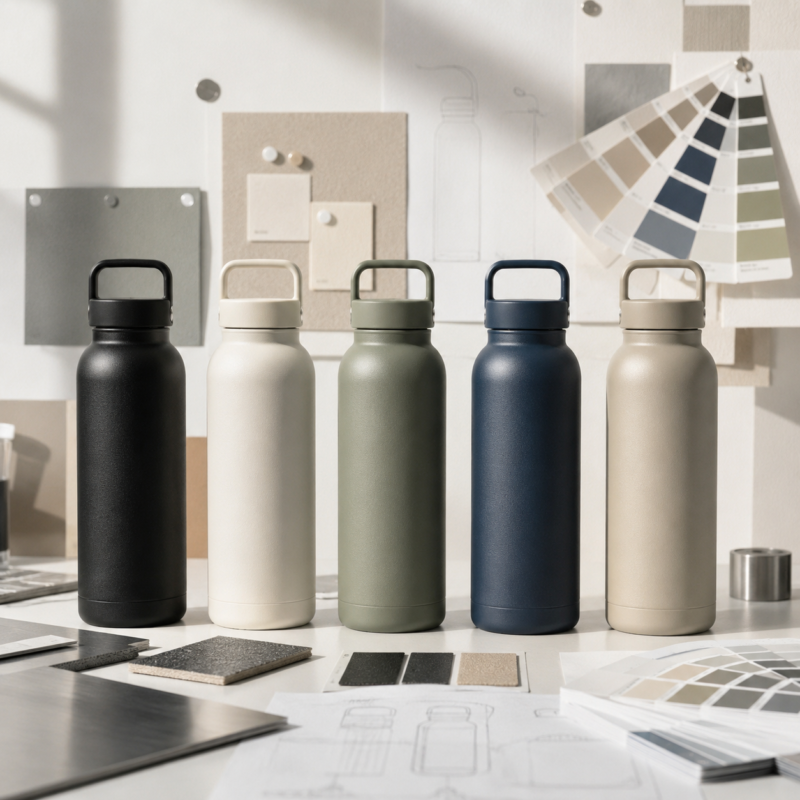
So wählen Sie Farben und Ausführungen für individuelle Wasserflaschen aus
Der Erfolg einer individuellen Wasserflaschenkollektion hängt nicht nur von attraktiven Farben ab. Auswahl der richtigen Farbpalette, Oberflächenbeschaffenheit, und die Fertigungsstrategie trägt zur Stärkung der Markenidentität bei, Kundenattraktivität verbessern, und sorgen für langfristige Umsätze. In diesem Leitfaden wird erläutert, wie Sie Farben basierend auf den Marktpräferenzen auswählen, Vergleichen Sie matte und glänzende Oberflächen, SKUs optimieren, und erreichen Sie durch professionelle OEM-Produktion eine gleichbleibende Qualität.
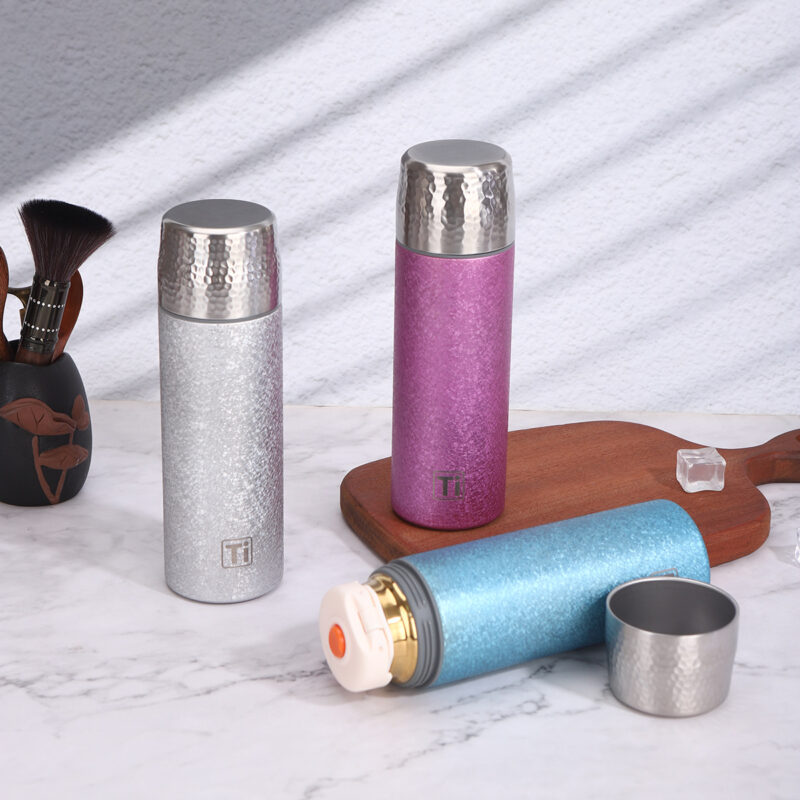
Sind Titanwasserflaschen sicher??
Titan ist sicher. Es ist auch teuer. Hier erfahren Sie, wie es im Vergleich zu Edelstahl und Aluminium abschneidet – und welches Material für Ihre Marke tatsächlich sinnvoll ist.
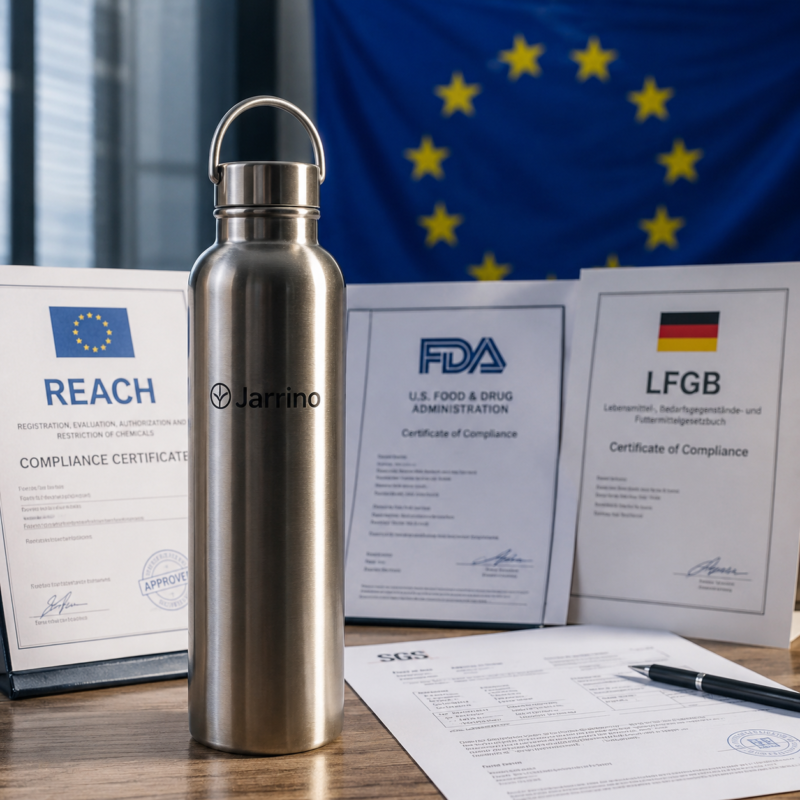
EU-Mikroplastik-Verordnung 2026: Was jeder Hersteller kundenspezifischer Wasserflaschen wissen sollte
Erfahren Sie, wie die EU-Mikroplastik-Verordnung funktioniert (EU) 2026/1168 wirkt sich auf Hersteller kundenspezifischer Wasserflaschen und Eigenmarken von Trinkgeschirr aus. Entdecken Sie, wie Jarrino Importeuren mit langlebigen Edelstahl-Wasserflaschen dabei hilft, REACH-konform zu bleiben.
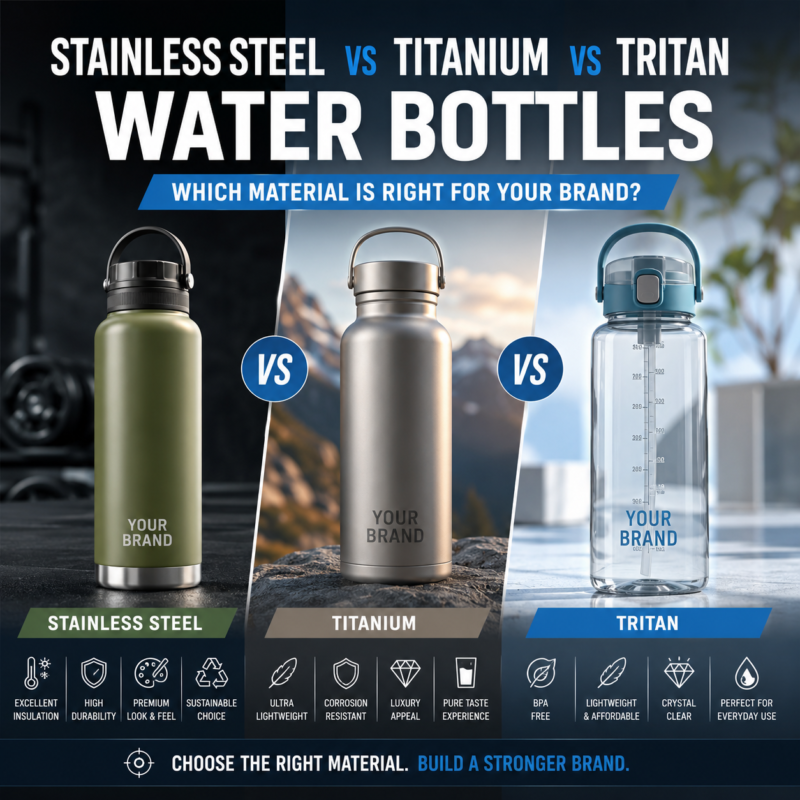
Stainless Steel vs Titanium vs Tritan Water Bottles: Which Material Is Right for Your Brand?
Choosing the right water bottle material can significantly impact your product quality, pricing, und Markenpositionierung. This guide compares stainless steel, Titan, and Tritan water bottles across durability, Isolierung, kosten, Anpassung, and sustainability to help brands, Einzelhändler, and OEM buyers select the best material for their target market.
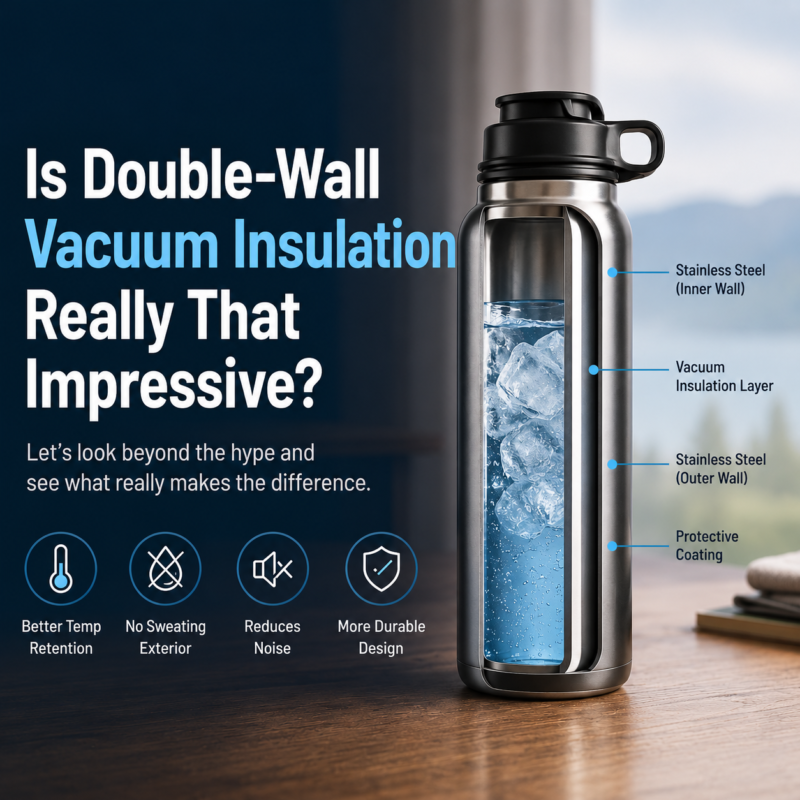
Ist die doppelwandige Vakuumisolierung wirklich so beeindruckend??
Double‑wall vacuum insulation is standard in premium drinkware, but the difference between a bottle that performs and one that disappoints comes down to manufacturing quality. This guide explains how vacuum insulation works, sets realistic performance expectations, and gives B2B buyers a practical checklist for evaluating suppliers. Plus, Warum die strengen Qualitätsstandards von Jarrino sicherstellen, dass Ihre maßgeschneiderten Flaschen halten, was sie versprechen.
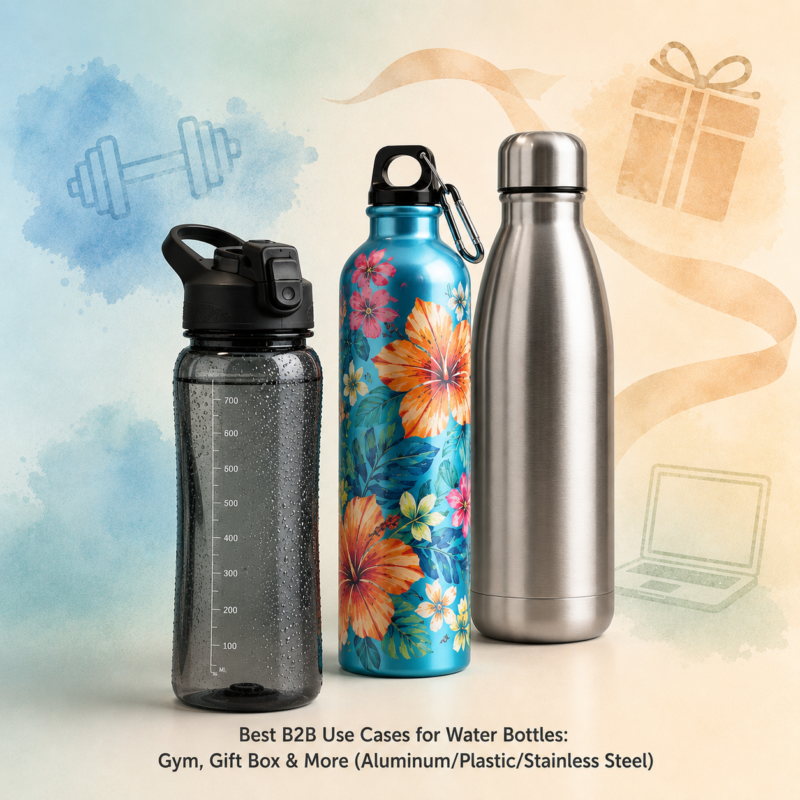
Beste B2B-Anwendungsfälle für Wasserflaschen: Fitnessstudio, Geschenkbox & Mehr (Aluminium/Kunststoff/Stahl)
Nicht jede Wasserflasche passt zu jedem B2B-Anwendungsfall. Dieser Artikel passt zu drei Materialien – Edelstahl, Aluminium, Kunststoff – bis hin zu realen Anwendungen: Fitnessstudios, Geschenkboxen für Unternehmen, Messen, Outdoor-Einzelhandel, und Schulprogramme. Edelstahl überzeugt durch Haltbarkeit und Isolierung. Aluminium bietet geringes Gewicht, Vollfarbiges Branding. Kunststoff ist für Großveranstaltungen budgetfreundlich (vorausgesetzt, es ist BPA-frei). Ein kurzer Spickzettel hilft B2B-Käufern, die Kosten auszugleichen, Markenimage, und Benutzererwartungen.
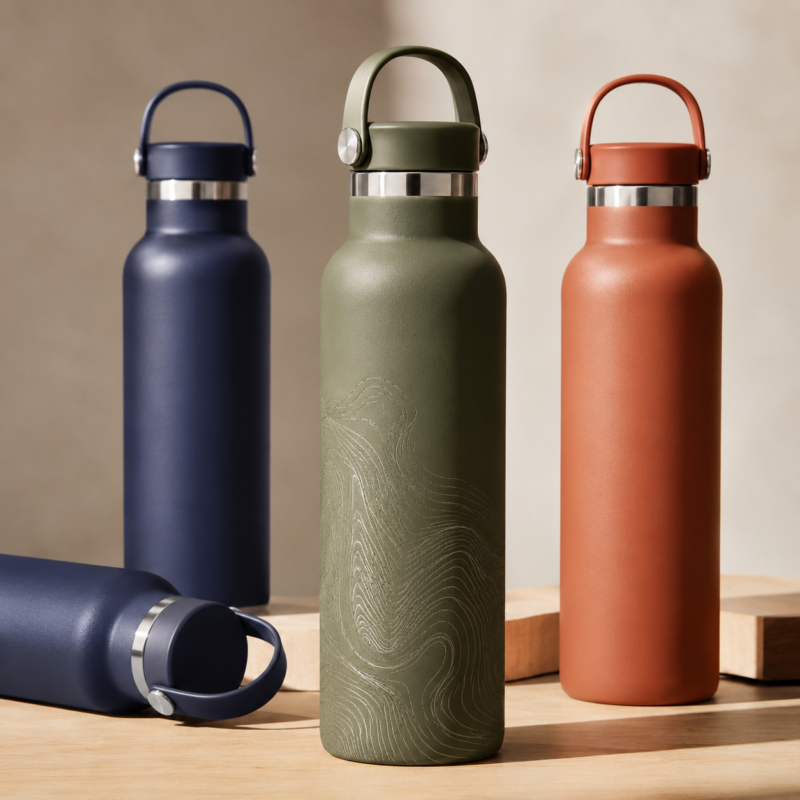
Welche individuelle Methode zur Dekoration von Wasserflaschen tatsächlich hält??
Lasergravur, Sublimation, UV, oder Siebdruck – welche individuelle Flaschendekoration tatsächlich den täglichen Gebrauch übersteht? Wir haben sie getestet. Lesen Sie die Ergebnisse.