
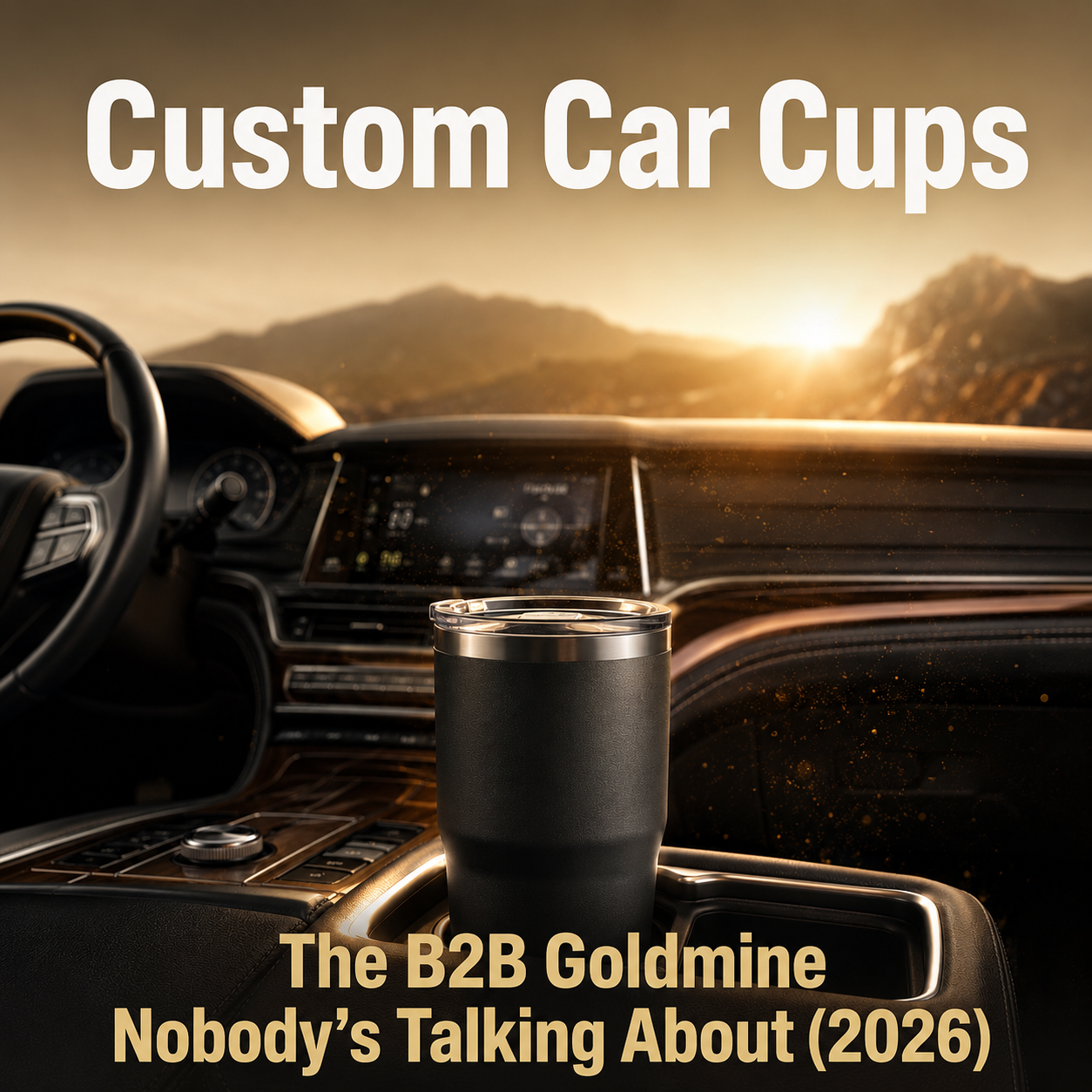
カスタムカーカップ: 誰も話題にしていない B2B のゴールドマイン (2026)
Every year, millions of branded water bottles are ordered by companies. They land on desks, in gym bags, at trade show booths. That market is crowded and noisy. But there is one drinkware category growing just as fast — with far less competition, deeper brand loyalty, and a higher daily impression count. Yet almost no one is talking about it.
We are talking about the custom car cup.
It is the insulated tumbler that lives in a vehicle’s cup holder. The mug a car dealer hands to every new buyer. The vessel an insurance agent gives to a long‑term client. It seems simple. But when it is done right, it becomes a daily‑use tool the driver relies on — and a branding asset that delivers hundreds of impressions per year, per unit.
At ジャリノ, we have manufactured custom drinkware for over 100 グローバルブランド. In the last 24 months, enquiries for vehicle‑specific, cup‑holder‑compatible insulated cups have more than doubled. Auto brands, fleet managers, outdoor gear lines, corporate gifting companies — all of them are waking up to this opportunity. This article explains why, what makes a car cup genuinely great, and how to source one that actually works from a factory that builds them every day.
1. Why Car Cups Are a B2B Goldmine Right Now
Let us start with the numbers behind the opportunity.
The global automotive accessories market was valued at approximately $540 billion in 2024 and is projected to grow at over 6.5% annually through 2031. Within this market, branded lifestyle accessories — drinkware, travel gear, apparel — are consistently the highest‑margin items for dealerships and aftermarket retailers. A single car sale can generate more than $2,000 in accessories revenue, and a high‑quality branded cup is one of the easiest upsells.
At the same time, the corporate gifting market is expected to reach $312 billion by 2025. Drinkware consistently ranks as one of the top three most popular promotional products year after year. A branded car cup sits precisely at the intersection of these two multi‑hundred‑billion‑dollar categories.
But the real B2B goldmine is not just in the market size. It is in the user behavior that no other promotional product can match.
-
- Daily, unavoidable impressions. A cup that lives in a car is seen every single day — by the driver, by passengers, by the person at the drive‑thru window, by the valet. No desk mug or tote bag competes with that frequency.
-
- Functional loyalty. A cup that fits perfectly in the cup holder, keeps coffee hot through a two‑hour commute, and never leaks earns genuine gratitude. The brand on that cup is not an intrusion — it is a daily companion. That is the most valuable kind of brand exposure.
-
- Replacement cycle measured in years. Unlike a phone case that changes with every new device, a well‑made stainless steel car cup lasts a decade. That means the brand logo stays in front of the user for years, not weeks.
-
- Predictable repeat orders. Corporate fleets, car dealerships, and insurance companies often refresh their branded merchandise annually. A satisfied client who orders 2,000 car cups this year will almost certainly order again next year — and the year after that.
For B2B suppliers, the car cup is not just a product. It is a client retention engine disguised as a drinkware item.
2. What Actually Makes a Cup a “Car Cup”
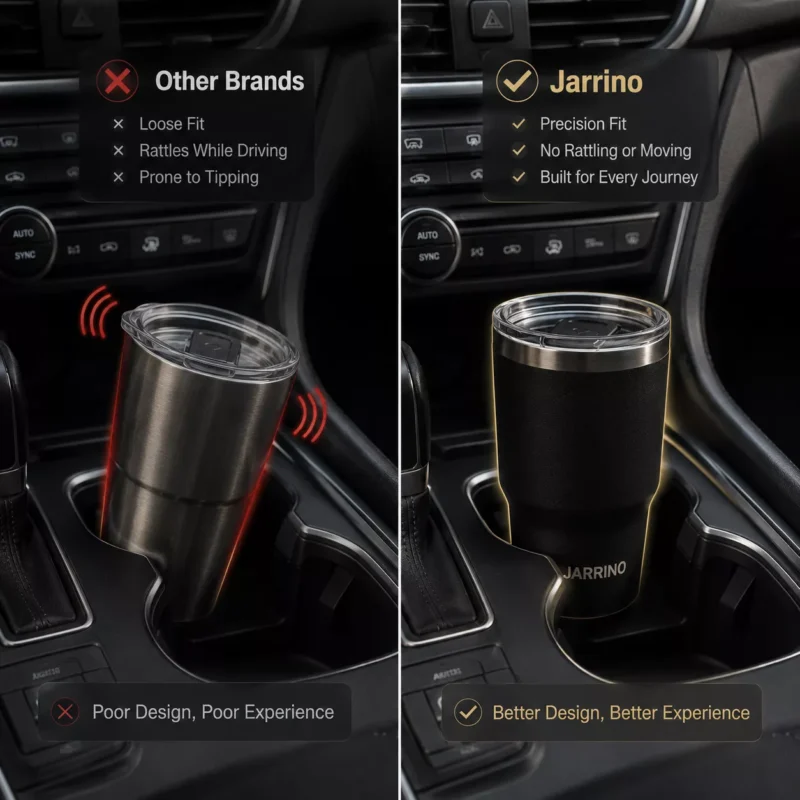
Here is the mistake we see constantly: a brand takes a standard straight‑wall tumbler, prints a logo on it, and markets it as a car cup. Then the complaints arrive. It rattles in the cup holder. It is too tall and hits the dashboard. The lid pops open when the car goes over a speed bump. The brand that ordered it looks incompetent.
A genuine car cup is an engineered product, not a decorated cylinder. These are the non‑negotiable design parameters, based on 15 years of manufacturing and testing at Jarrino.
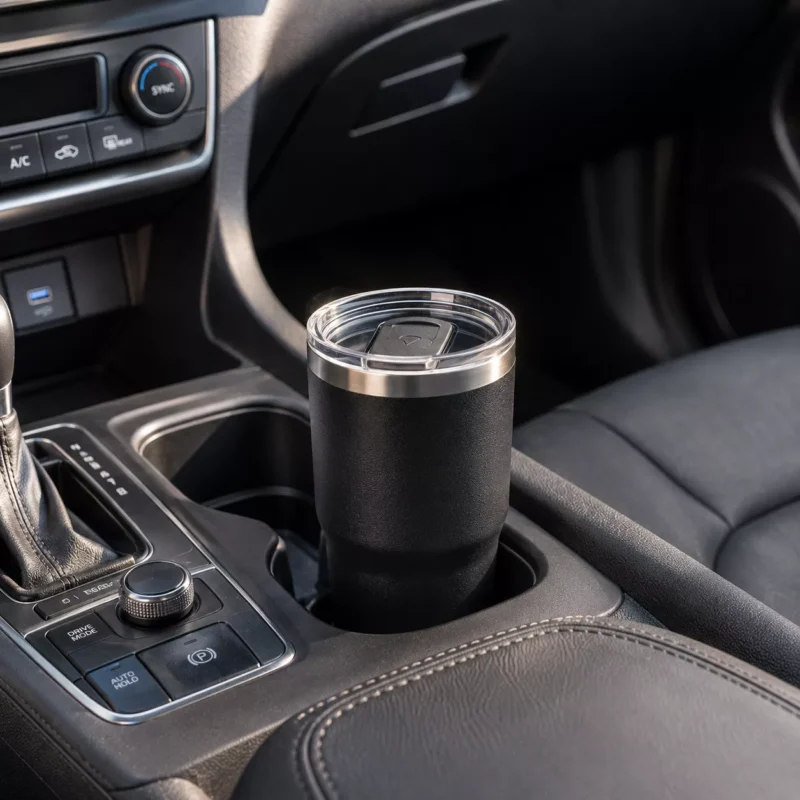
Cup‑holder compatibility.
Most vehicle cup holders have a base diameter between 65 そして 80 mm, tapering wider toward the top. A car cup must have a narrowed base section that sits securely without wobbling. We design our standard car cup with a bottom diameter of 68–72 mm for universal fit, with a controlled upward taper. This is not guesswork — we maintain a database of cup‑holder dimensions from the top 50 vehicle models sold globally.
Height clearance.
The distance between a cup holder and the dashboard or centre console overhang varies widely by vehicle. Our testing across Toyota, Honda, Ford, VW, and Tesla models shows that a total cup height of 180–200 mm stays safely clear of obstructions in almost every common vehicle. Taller than that, and the cup will hit the dash in compact cars.
One‑hand operation.
The driver’s other hand is on the steering wheel. The lid must open with one thumb — a spring‑loaded push‑button or a smooth slide mechanism — and close securely with the same single hand. We test every lid design for one‑hand ergonomics using a standardized grip simulation.
Zero‑leak lid engineering.
A car cup does not live an upright, stationary life. It gets tossed onto the passenger seat, knocked sideways in a bag, or held at an angle while drinking. The lid seal must survive all of these scenarios without a single drip. This requires precision‑molded food‑grade silicone gaskets, a secure locking mechanism (bayonet or threaded), and thermal expansion tolerance so the seal does not fail when the car interior hits 60°C in summer.
Thermal performance for real vehicle conditions.
A parked car in summer can exceed 60°C inside. A car in a northern winter can drop to -20°C. The cup’s vacuum insulation must handle both extremes without degrading. At Jarrino, we thermal‑shock test our car cup designs by cycling them from -20°C to 100°C repeatedly to confirm vacuum integrity.
Finish that survives daily abuse.
A car cup is constantly handled, rotated in cup holders, and exposed to direct sunlight through the windshield. The exterior finish must resist scratching, chipping, and UV fading. This demands a high‑quality electrostatic powder coat, baked at precise temperatures and tested for adhesion and durability — not a cheap wet‑paint application that peels after six months.
If your supplier cannot speak to every one of these points with specific engineering answers, they are likely reselling a generic tumbler, not manufacturing a real car cup.
3. Four B2B Buyer Profiles
At ジャリノ, we see car cup buyers fall into four main categories. Each has different needs, order volumes, and margin structures. Identifying which one you are — or which one your customers belong to — shapes everything from product design to pricing.
Type 1: Auto Dealerships & Car Brands
What they need: A premium branded car cup to give as a new‑car gift, sell in the accessories section, or include in service‑lane loyalty programs.
Typical order: 1,000–10,000 units annually.
Key requirements: Laser‑engraved brand logo, exact Pantone color matching to the brand palette, gift‑box packaging, and sometimes vehicle‑model‑specific designs.
Margin note: Dealerships often retail these at 3–4x landed cost, so per‑unit investment is less price‑sensitive — quality and brand alignment are everything.
Type 2: Corporate Fleets & Promotional Buyers
What they need: Branded car cups for employee onboarding, client gifts, or trade‑show giveaways.
Typical order: 500–5,000 units per campaign.
Key requirements: Fast turnaround, consistent logo reproduction, bulk packaging, and reliable re‑order consistency so this year’s cup matches last year’s.
Margin note: These buyers prioritize per‑unit cost and re‑order predictability above all else.
Type 3: Outdoor & Overlanding Gear Brands
What they need: A rugged, high‑performance car cup sold alongside coolers, roof racks, and portable stoves.
Typical order: 300–2,000 units per SKU.
Key requirements: Extreme durability finishes (例えば, matte textured powder coat), larger capacity (500–700 ml), compatibility with aftermarket cup‑holder expanders, and sustainable packaging.
Margin note: These brands can command retail prices of $35–$55 per cup, so they willingly invest in 316 ステンレス鋼, custom lid mechanisms, and premium finishes.
Type 4: E‑commerce B2C Brands Expanding into Car
What they need: A car‑cup SKU to complement an existing drinkware line heavy on lifestyle bottles and tumblers.
Typical order: 500–3,000 units.
Key requirements: Aesthetic alignment with existing product lines, matching colorways and finishes, drop‑ship‑ready packaging, and content assets for online listings.
Margin note: Speed to market and content support are often as important as unit cost for these buyers.
If you are reading this on the Jarrino blog, you almost certainly fit one of these profiles — or you are supplying one. Knowing exactly which changes the entire sourcing conversation.
4. What a Car Cup Order Actually Costs
Here are real numbers based on our factory’s experience.
| Component | Private Label / ODM (existing design) | Full OEM (custom design) |
|---|---|---|
| Moq | 500 ユニット (200 for trial orders) | 1,000–3,000 units |
| Unit cost, 304 SS, 450 ミリリットル | $3.00 – $5.50 | $4.00 – $7.00 |
| Unit cost, 316 SS, 500 ミリリットル | $4.50 – $7.50 | $5.50 – $9.50 |
| Custom lid mechanism | Not available (use existing) | +$0.80 – $2.00/unit |
| Mold / tooling investment | $0 (既存の金型) | $2,500 – $8,000+ |
| Custom packaging | $0.50 – $1.50/unit | $0.80 – $2.00/unit |
| Sampling time | 5–7 days | 4–6 weeks |
| Production lead time | 25–30日 | 40–55 days |
| Sea freight (500 ユニット) | $400 – $800 | $400 – $800 |
For a typical corporate fleet buyer ordering 500 private‑label car cups at $4.50/unit, the product cost is around $2,250. Adding packaging, logo setup, and freight, the total delivered cost realistically lands between $4,500 そして $6,500, depending on destination.
A full OEM project with a custom lid and exclusive mold requires a budget of $15,000–$30,000 for the first production run. This is not a barrier — it is the price of owning a product no competitor can duplicate.
At ジャリノ, our standard MOQ is 500 個, but we accept trial orders as low as 200 units for existing designs with custom color and logo modifications. We publish our 認証 openly and encourage every potential client to ask difficult questions — because a factory that welcomes scrutiny is a factory that delivers consistency.
5. How Jarrino Prevents the Most Common Car Cup Failures
以上 15 年, we have seen car cups fail in the same predictable ways. Here is how we engineer those failures out of existence.
| Failure Mode | The Cheap Approach | The Jarrino Standard |
|---|---|---|
| Lid leaks in a hot car | Thin, generic gasket with no thermal tolerance. | Food‑grade silicone gasket, Shore hardness 50±5, tested for seal integrity at 80°C for 24 時間. Every lid passes a dedicated leak‑test station. |
| Vacuum fails after a drop | Single‑point welding or micro‑porous low‑grade steel. | High‑temperature copper brazing under vacuum atmosphere, plus a helium leak test on every unit. Vacuum defect rate under 0.3%. |
| Powder coat peels after months | Low‑temp wet paint or single‑coat powder with poor adhesion. | 3‑layer electrostatic powder coating (primer + 色 + clear topcoat) baked at 200°C. Coating thickness verified at 60–80 microns. Every batch undergoes cross‑hatch adhesion testing (ISO 2409) and a 500‑hour salt spray test (ASTM B117). |
| Cup wobbles or doesn’t fit | Generic “one size fits all” with no vehicle data. | Base diameter precision‑stamped to 70 mm ±0.5 mm, validated against a database of cup‑holder dimensions from 50 top‑selling vehicle models. Physical fit checks in Toyota, Honda, Ford, VW, and Tesla rigs. |
| Engraving fades or smudges | Low‑power laser, no post‑treatment. |
30W fiber laser marking, depth‑controlled engraving (0.03–0.05 mm into the steel), followed by ultrasonic cleaning and passivation to prevent oxidation in the engraved area. |
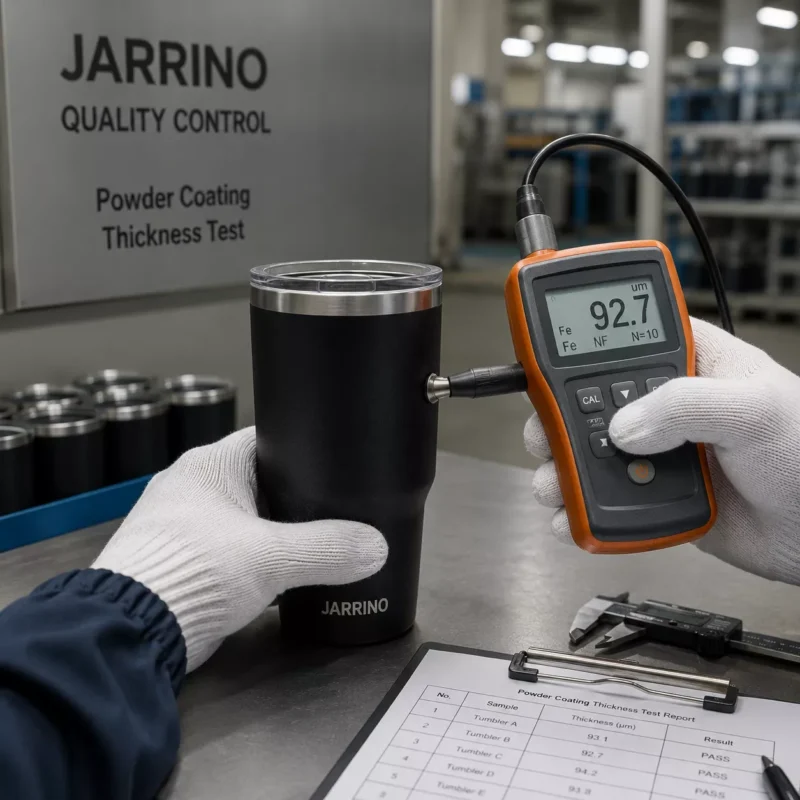
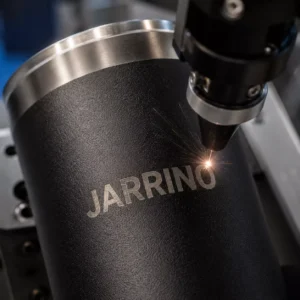
If you tour a Jarrino production line — in person or via live video — you can see every one of these quality gates in action. That transparency is not a marketing tactic. It is the reason over 100 brands return to us year after year.
6. How to Start Your Car Cup Project with Jarrino
Here is the step‑by‑step process we guide every B2B client through.
Step 1: Define your use case.
Which buyer type are you? Dealership, fleet, outdoor gear, or e‑commerce? That decision determines capacity, lid style, finish, と包装.
Step 2: Choose your product path.
-
- Private Label / ODM: Select an existing Jarrino car cup design. We customize color and logo. Fastest route to market.
-
- Full OEM: Provide your design concept. Our team delivers 3D renderings in 72 時間, physical prototypes in 10 日, and a pilot batch of 500 units for functional testing before full production.
Step 3: Lock in the lid.
The lid is the heart of a car cup. We help you select or design a push‑button slide, flip‑top, screw‑on with handle, or a fully custom mechanism — all tested for one‑hand use, leak‑proofing, and dishwasher safety.
Step 4: Finalize finishes and branding.
Options include matte or glossy powder coat, sandblasted raw steel, gradient color fades, rubberized grip bases, and laser‑etched patterns. Logo methods: deep laser engraving, silk screen, UV digital printing, embossed metal badges.
Step 5: Validate with a trial run.
We always recommend a 200‑unit trial batch. Distribute them to real users. Collect feedback. Refine. Then scale with confidence.
Step 6: Production, 品質管理, and logistics.
Our in‑house QC team — operating to CNAS‑level laboratory standards — inspects every batch for material composition, vacuum integrity, lid seal, coating adhesion, and dimensional accuracy. We handle FOB shipping or recommend trusted freight forwarders for door‑to‑door delivery.
Ready to explore the opportunity? Visit our OEM and private label page または browse our drinkware catalog . Prefer a direct conversation? Contact our team for a no‑obligation consultation — we will talk through your use case, budget, and timeline and give you straight, honest answers.
7. Frequently Asked Questions
Q: Can I really start with just 200 cups?
A: はい. Jarrino’s trial order minimum is 200 units for existing car cup designs with custom logo and color. This lets you test the market, validate fit, and gather user feedback before committing to a full production run.
Q: How long does a car cup project take?
A: Private label: samples in 5–7 days, production in 25–30 days, plus 3–5 weeks sea freight — roughly 8–12 weeks total. Full OEM with custom tooling: allow 4–6 months.
Q: Can you match my brand’s exact Pantone color?
A: はい. We use spectrophotometer‑based color matching and can achieve a Delta E of less than 1.0 against your target Pantone code. Physical color swatches are provided for approval before production.
Q: What certifications do your car cups carry?
A: Standard certifications include FDA, LFGB, 到着, and California Proposition 65. We can also supply EU 10/2011 migration test documentation on request. All certificates are published on our website.
Q: Do you offer custom packaging?
A: はい. We produce retail boxes, gift tubes, magnetic‑closure boxes, and bulk packaging. Packaging design support is included for orders above 1,000 ユニット. MOQ for custom packaging is typically 500–1,000 units.
Q: What if the cups don’t fit my specific vehicle model?
A: We ask for target vehicle models before production and validate dimensions against our cup‑holder database. We also provide physical samples for in‑vehicle fit checks. Mass production does not begin until fit is confirmed.
8. The Bottom Line
The car cup is not a passing fad. It is a daily‑use, long‑life product sitting at the intersection of a $540 billion automotive accessories market and a $312 billion corporate gifting industry. For B2B buyers, it offers something rare: high‑frequency brand impressions, genuine user loyalty, and a repeat‑order cycle that most promotional products cannot match.
But only if the cup actually works.
A car cup that leaks, rattles, peels, or does not fit a cup holder is worse than useless — it actively damages the brand printed on it. That is why factory selection matters more for car cups than for almost any other drinkware category. The tolerances are tighter. The testing is harder. The engineering is less forgiving.
At Jarrino, we have spent 15 years learning what makes a car cup survive — and thrive — in real vehicles, in real heat, in real daily use. We do not just decorate generic tumblers. We design, test, and manufacture car cups that meet the actual engineering requirements of life on the road.
If you are sourcing car cups for a brand, a dealership, a fleet, or a retail line, talk to us before you commit. We will help you get the product right — because a cup that fails in the cup holder is a cup that never gets reordered.
Contact Jarrino to discuss your car cup project
Related Posts
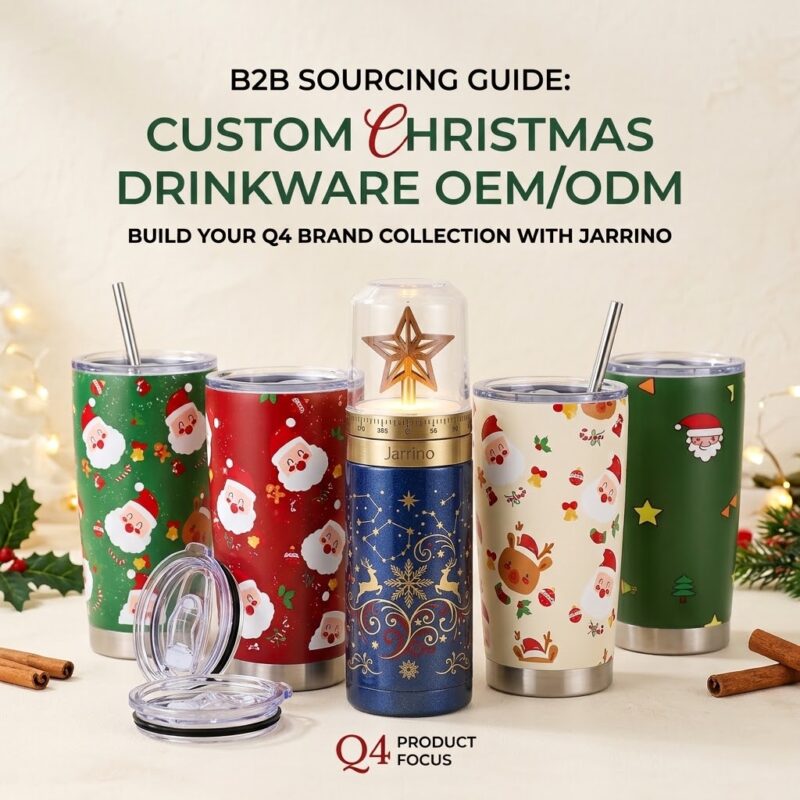
Custom Christmas Drinkware: Complete OEM/ODM Manufacturing Guide
Jarrino is a certified OEM/ODM manufacturer specializing in custom vacuum flasks, ceramic-lined tumblers, and titanium drinkware. Lead times for Q4 custom Christmas orders are 20–30 days with low MOQs (300–1,000 pcs) and full FDA/LFGB compliance. We offer end-to-end customization including 3D digital printing, レーザー彫刻, and bespoke Christmas gift packaging. Sample kits and the quotes are available upon request to help brands lock in Q4 holiday production smoothly.
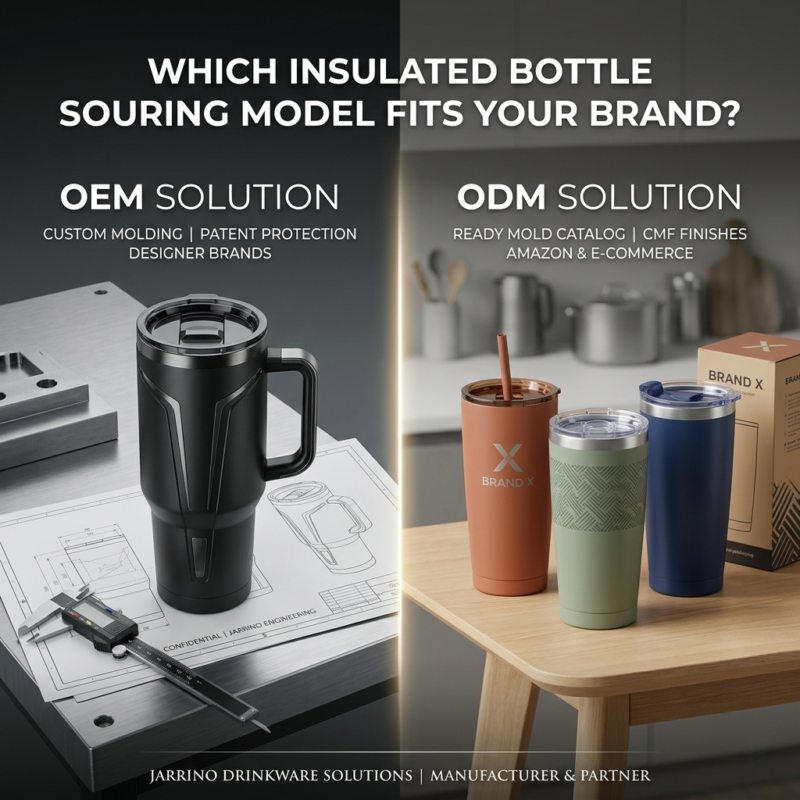
OEM vs. ODM Insulated Tumblers: Which Sourcing Model Fits Your Drinkware Brand
Choosing between OEM (Original Equipment Manufacturing) and ODM (Original Design Manufacturing) defines your drinkware brand’s R&D budget, time-to-market, and product exclusivity. OEM is ideal for established brands with custom CAD designs and unique IP requirements, offering 100% custom molding and patent protection. ODM is built for Amazon sellers, DTC startups, and corporate buyers seeking zero tooling costs, low MOQs, and rapid product launches via advanced CMF finishes (powder coating, UV印刷).
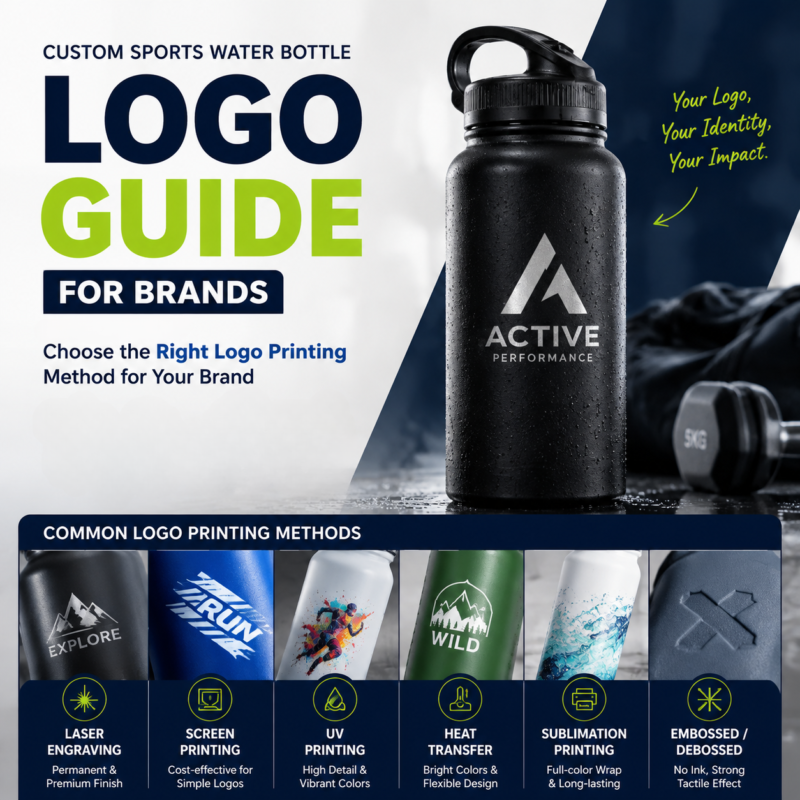
ブランド向けカスタム スポーツ ウォーター ボトル ロゴ ガイド
カスタムスポーツウォーターボトルのロゴは、ボトルの素材に応じてさまざまな装飾プロセスを経て作成されます。, ブランドデザイン, およびパフォーマンス要件. このガイドでは、最も一般的なロゴの印刷方法について説明します。, レーザー彫刻を含む, スクリーン印刷, UV印刷, 熱伝達, そして昇華, スポーツ ブランドが耐久性のあるプロ仕様のドリンクウェア製品に適切なカスタマイズ オプションを選択できるよう支援します。.
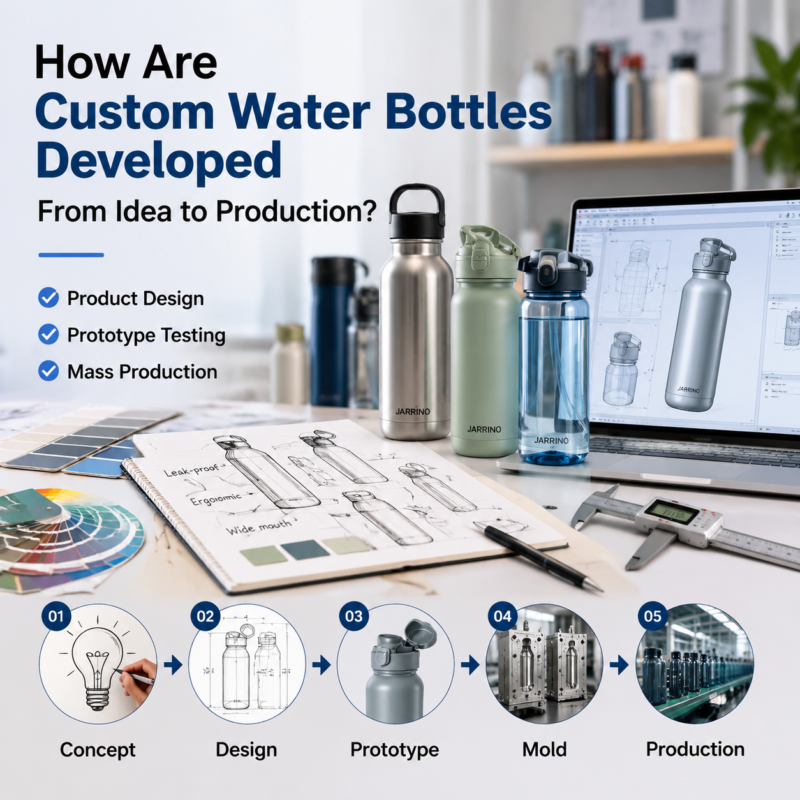
カスタムウォーターボトルはアイデアから製造までどのように開発されるのか?
カスタム ウォーター ボトルの開発には、デザインを選択してロゴを追加するだけでは不十分です. 初期の製品コンセプトからエンジニアリングまで, プロトタイピング, 金型開発, テスト, そして大量生産, ドリンクウェア製品を成功させるには、すべての段階が重要な役割を果たします. このガイドでは、ブランドが OEM ウォーターボトル メーカーと協力してアイデアを高品質なものに変える方法について説明します, 設計を管理しながら市場に投入できる製品を開発, 料金, 生産上の課題.
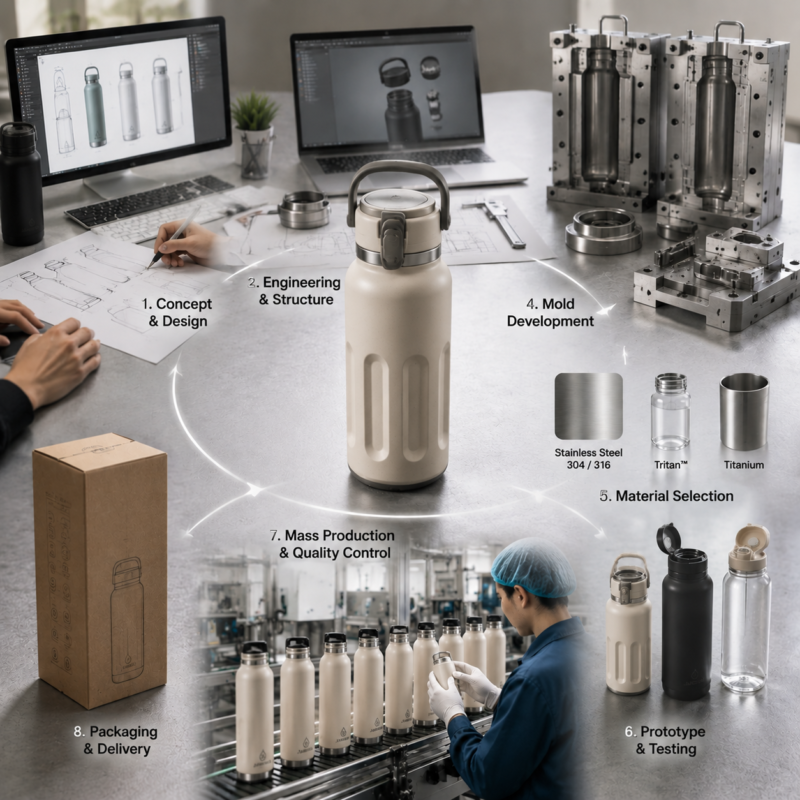
フルオーダーメイドのウォーターボトルはどのように作られるのか?
フルカスタムのウォーターボトルの開発には、既存の製品にロゴを追加するだけでは不十分です。. このガイドでは、ブランドが製品デザインを通じてどのようにユニークなウォーターボトルを作成するかを説明します。, エンジニアリング, 材料の選択, 金型開発, プロトタイプのテスト, そして大量生産. 経験豊富な OEM ウォーター ボトル メーカーが、品質を管理しながらアイデアを市場に投入できる製品に変える方法を学びましょう, 料金, および生産効率.
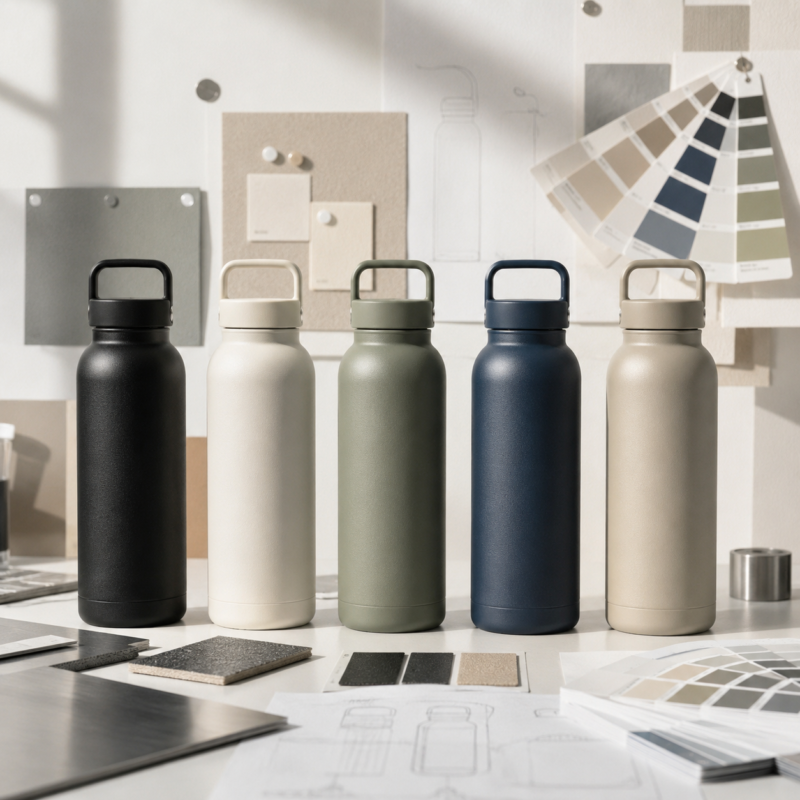
カスタムウォーターボトルの色と仕上げの選び方
カスタム ウォーター ボトル コレクションの成功は、魅力的な色以上のものにかかっています。. 適切なカラーパレットの選択, 表面仕上げ, 製造戦略はブランドアイデンティティの強化に役立ちます, 顧客の魅力を向上させる, 長期的な販売を確保する. このガイドでは、市場の好みに基づいて色の選択方法を説明します。, マット仕上げと光沢仕上げを比較する, SKUの最適化, 専門的なOEM生産を通じて一貫した品質を実現します.
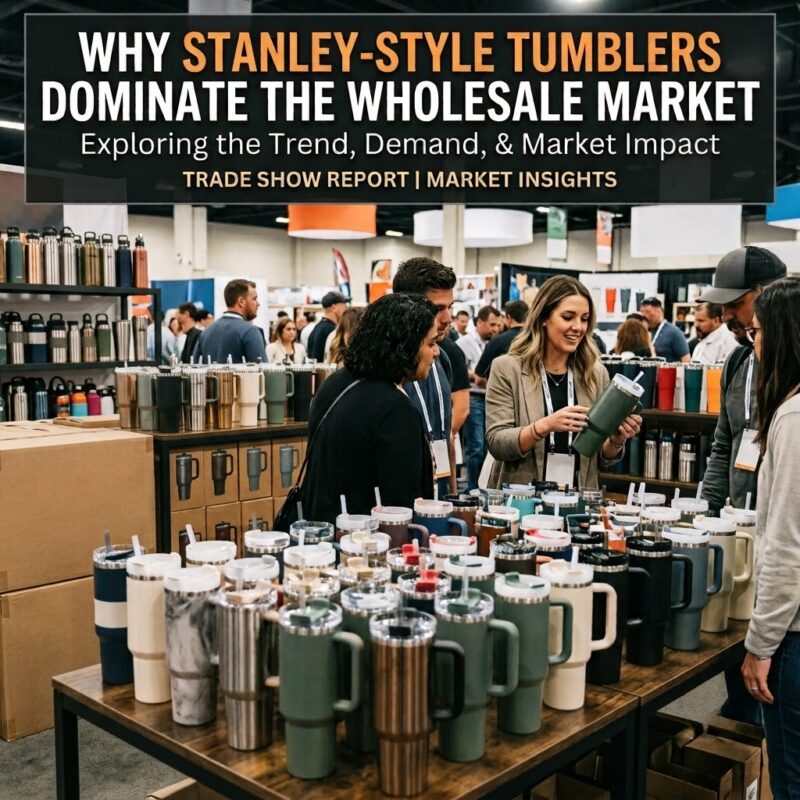
スタンレースタイルのタンブラーが卸売市場を独占する理由
スタンレースタイルのタンブラーは文化現象となり、卸売のベストセラーとなった. この記事では、その理由を探ります。 18/8 ステンレス鋼と二重壁真空断熱材で高い価値を実現, カスタマイズの可能性, 安定したリピート需要. これらのタンブラーが信頼できる理由を学びましょう, 卸売りバイヤーにとって収益性の高いカテゴリー.
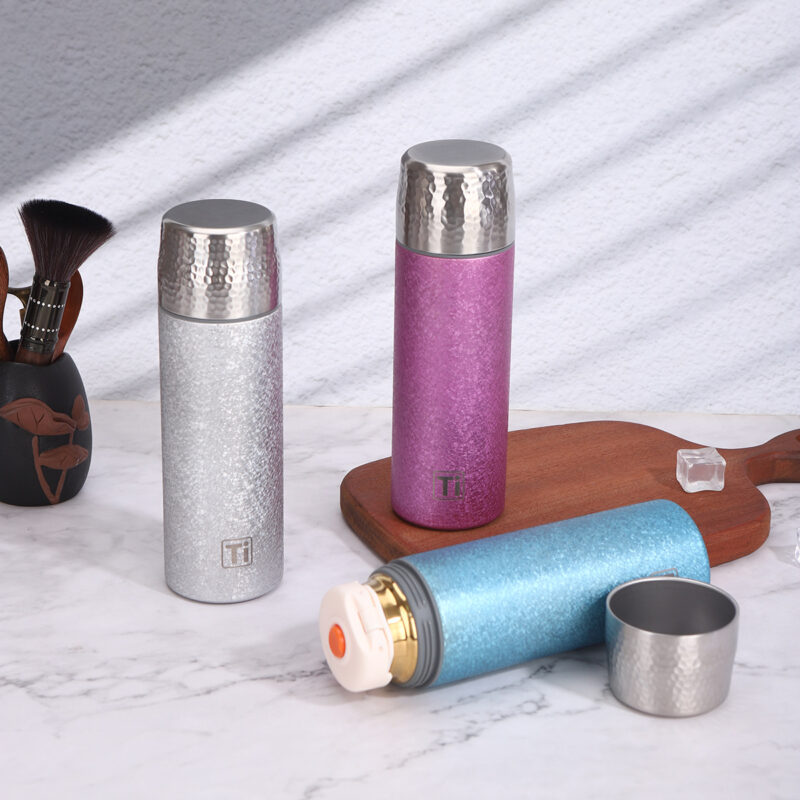
チタン製ウォーターボトルは安全ですか?
チタンは安全です. それも高価です. ステンレス鋼やアルミニウムとどのように比較するのか、そしてどの素材があなたのブランドにとって実際に意味があるのかを以下に示します。.
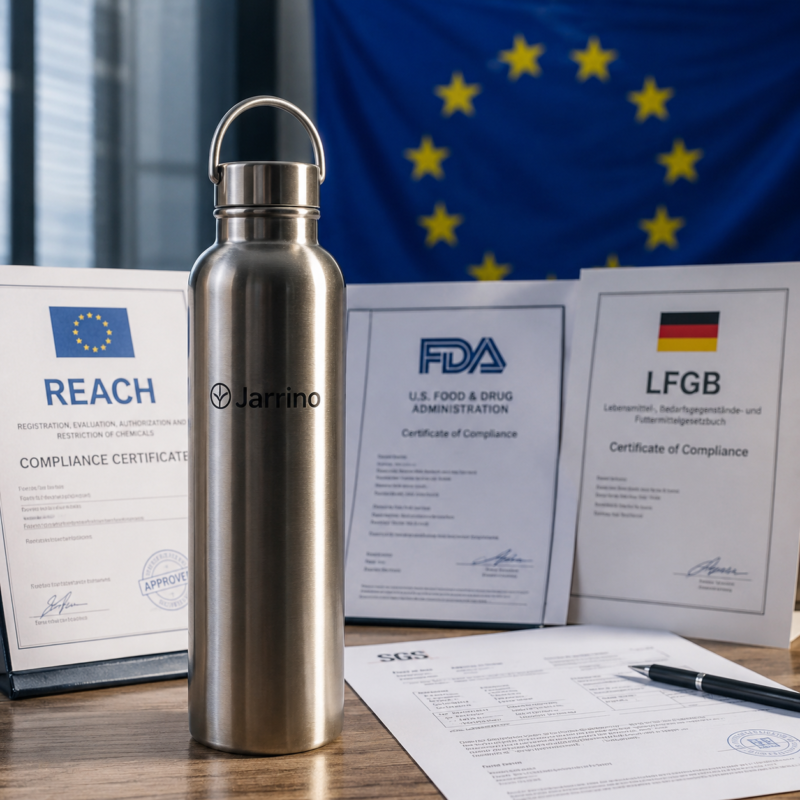
EU Microplastics Regulation 2026: What Every Custom Water Bottle Manufacturer Should Know
Learn how the EU Microplastics Regulation (EU) 2026/1168 impacts custom water bottle manufacturers and private label drinkware brands. Discover how Jarrino helps importers stay REACH compliant with durable stainless steel water bottles.
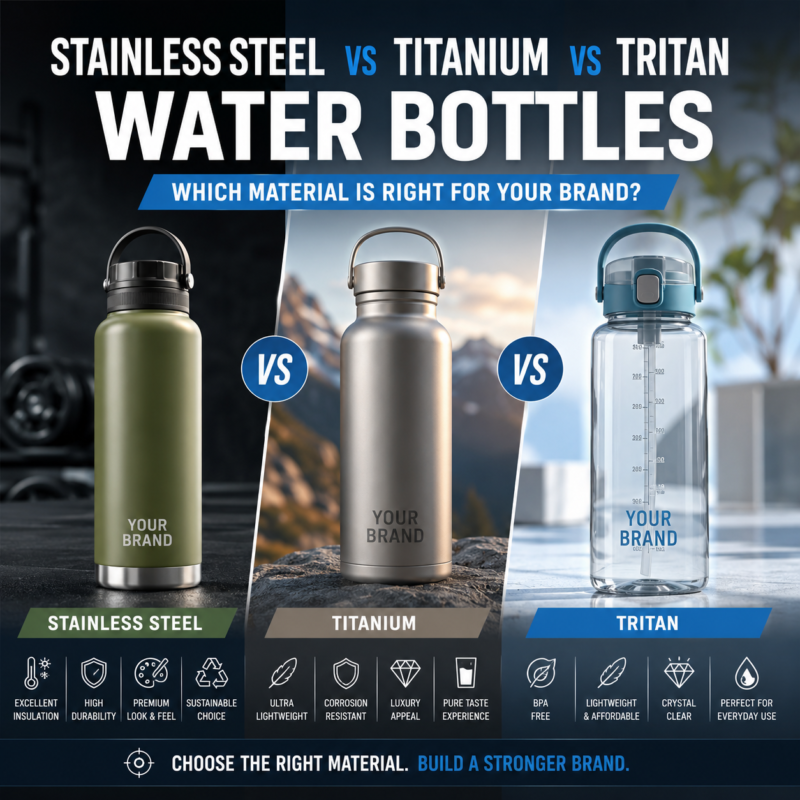
Stainless Steel vs Titanium vs Tritan Water Bottles: Which Material Is Right for Your Brand?
Choosing the right water bottle material can significantly impact your product quality, pricing, and brand positioning. This guide compares stainless steel, チタン, and Tritan water bottles across durability, insulation, 料金, カスタマイズ, and sustainability to help brands, 小売業者, and OEM buyers select the best material for their target market.
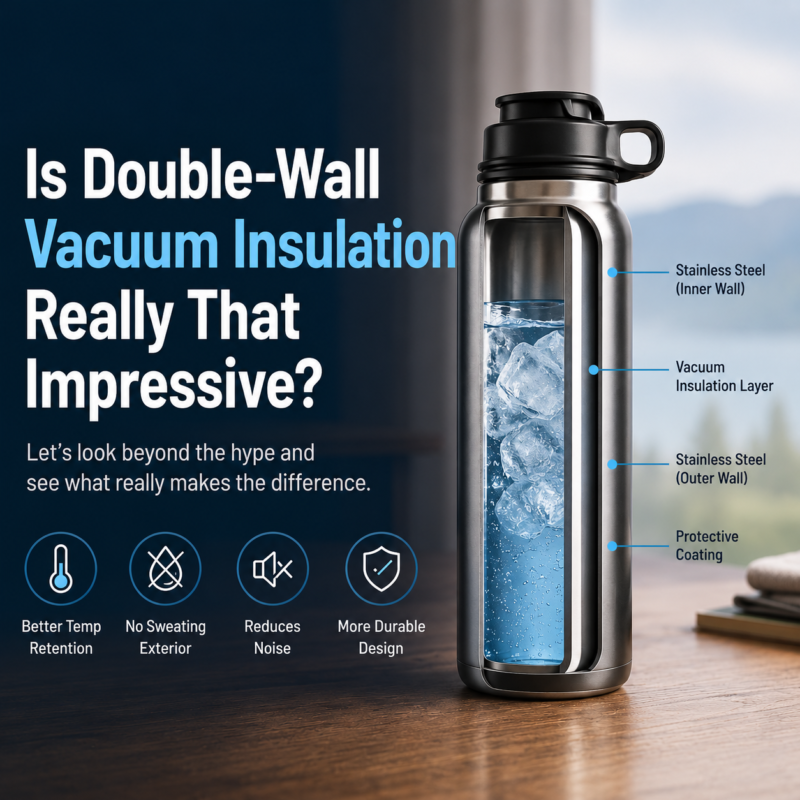
二重壁真空断熱材は本当にすごいのか?
Double‑wall vacuum insulation is standard in premium drinkware, but the difference between a bottle that performs and one that disappoints comes down to manufacturing quality. This guide explains how vacuum insulation works, sets realistic performance expectations, and gives B2B buyers a practical checklist for evaluating suppliers. Plus, why Jarrino’s strict quality standards ensure your custom bottles deliver on their promises.
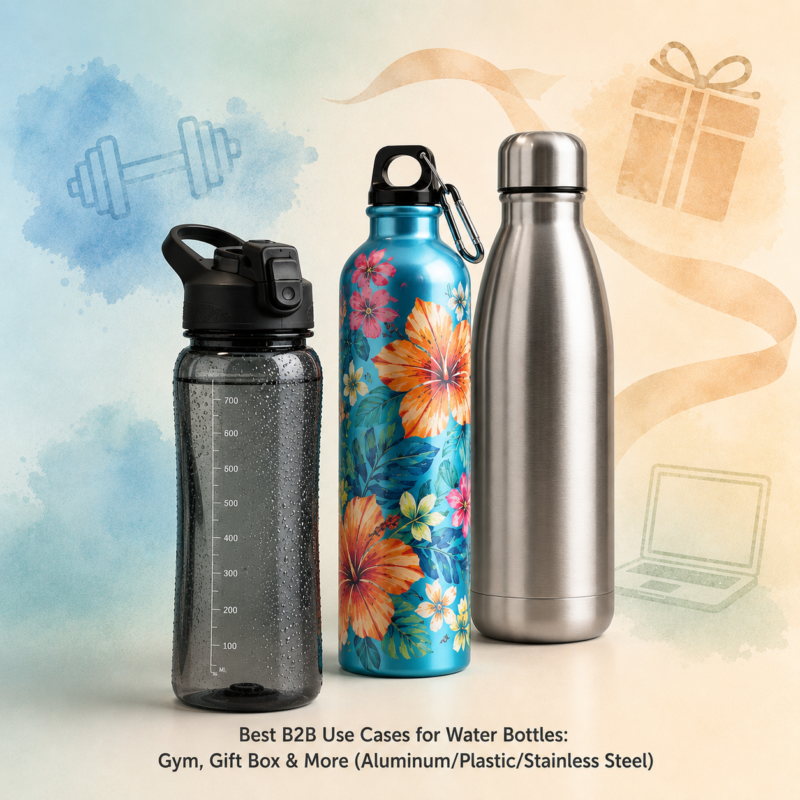
ウォーターボトルのベスト B2B ユースケース: ジム, ギフトボックス & もっと (アルミニウム/プラスチック/スチール)
すべてのウォーターボトルがすべての B2B ユースケースに適合するわけではありません. この記事は 3 つの素材に適合します - ステンレス鋼, アルミニウム, プラスチック — 現実世界の用途へ: ジム, 企業向けギフトボックス, トレードショー, 屋外小売, そして学校のプログラムも. ステンレス鋼は耐久性と断熱性で優れています. アルミニウムは軽量性を提供します, フルカラーのブランディング. プラスチックは大規模イベント向けに予算に優しい (BPAフリーであることが条件). B2B購入者がコストのバランスをとるのに役立つ簡単なチートシート, ブランドイメージ, そしてユーザーの期待.