

Cómo elegir vasos personalizados sostenibles para su marca?
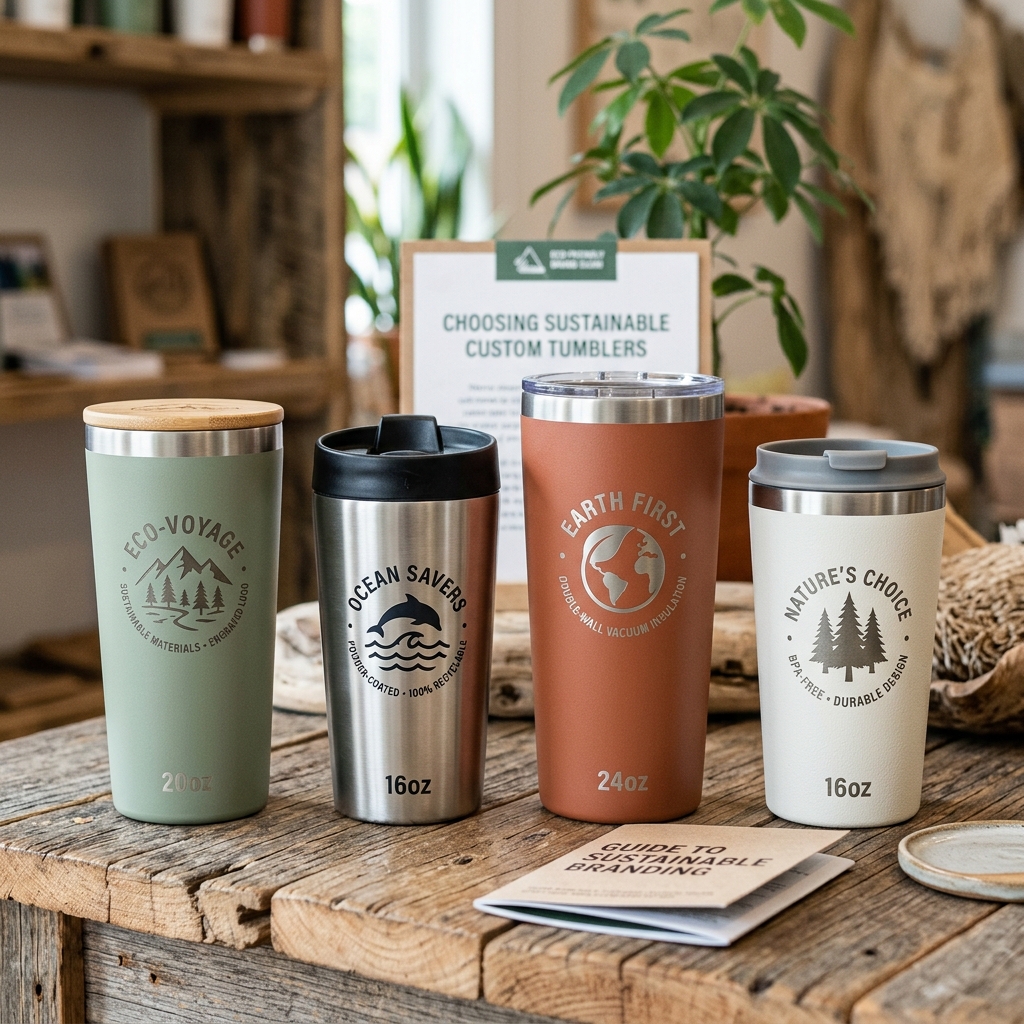
Quick Answer: What Makes a Custom Tumbler Sustainable ?
A sustainable custom tumbler is not defined by one material or an “eco-friendly” label. For European brands, sustainability increasingly depends on the entire product lifecycle: selección de material, durabilidad, reutilización, recycled content, fabricación, embalaje, compliance, and supply-chain transparency.
For most premium reusable drinkware brands, durable stainless steel—especially when certified recycled content is available—can be a strong option. Recycled plastics can also be useful for lightweight bottles and components, but food-contact requirements and recycled-content claims need to be properly documented.
En 2026, European buyers should evaluate a custom tumbler based on measurable product attributes rather than broad environmental claims.
Why Sustainable Drinkware Matters More to European Brands?
Sustainability has moved beyond a marketing trend. It is becoming part of product development, packaging decisions and supply-chain management for brands selling in Europe.
The European Union has a broad regulatory framework covering both food-contact materials and packaging. Under Regulation (CE) No 1935/2004, food-contact materials must not transfer substances into food at levels that could harm health or cause unacceptable changes to food composition, taste or smell. The framework applies to materials such as plastics, vaso, paper and metals.
Al mismo tiempo, the EU’s Packaging and Packaging Waste Regulation (PPWR), Regulation (UE) 2025/40, began applying on 12 August 2026. It introduces a harmonised framework for packaging placed on the EU market, with requirements covering packaging design, composition, recyclability, waste prevention and reuse.
For drinkware brands, this creates an important distinction:
A sustainable product is not simply a product made from recycled material. It is a product designed to perform well, last longer, use appropriate materials, minimise unnecessary packaging and support responsible end-of-life management.
This is why European brands sourcing custom tumblers should evaluate the complete product system, rather than focusing on one environmental claim.
1. Recycled Stainless Steel: One of the Strongest Options for Custom Tumblers
Stainless steel remains one of the most practical materials for reusable insulated drinkware because it combines durability, corrosion resistance and long service life.
When recycled stainless steel is used, the material story becomes even more relevant for brands with sustainability objectives.
The market is already moving in this direction. Por ejemplo, Stanley states that 81% of its stainless steel units were made with recycled stainless steel in 2025, while some of its products use up to 90% recycled stainless steel.
European promotional drinkware suppliers are also increasingly offering recycled stainless steel bottles and tumblers, including products using RCS- or GRS-certified recycled content.
Recycled vs. Virgin Stainless Steel
| Factor | Recycled Stainless Steel | Virgin Stainless Steel |
|---|---|---|
| Recycled content | Sí, when verified | Generally no |
| Durabilidad | Alto | Alto |
| Suitable for insulated drinkware | Sí | Sí |
| Sustainability positioning | Stronger when certified | More traditional |
| Documentation | Should include verified recycled-content information | Material specification and compliance documents |
| Brand storytelling | Strong | Moderado |
Sin embargo, brands should avoid treating “recycled stainless steel” as automatically equivalent to a specific environmental performance.
The key question is:
How much recycled content does the product actually contain, and can that claim be verified?
For B2B buyers, certifications or supplier documentation can be more valuable than a generic “eco” claim.
What Should Brands Ask a Manufacturer?
Before ordering recycled stainless steel tumblers, ask:
- What percentage of the stainless steel is recycled?
- Is the recycled content independently certified?
- What stainless steel grade is used?
- Is the material suitable for food contact?
- Can the supplier provide material or compliance documentation?
- Is recycled content used in both the inner and outer walls?
- Can the recycled material percentage remain consistent during mass production?
These questions help turn sustainability from a marketing statement into a measurable purchasing specification.
2. Recycled Plastic: Useful, but Certification Matters
Stainless steel is not the only sustainable material option.
Recycled plastics can be appropriate for lightweight sports bottles, transparent drinkware and specific components.
Materials such as recycled PET or recycled-content plastics can help brands reduce reliance on virgin plastic, but European brands need to pay particular attention to food-contact safety and traceability.
The European Commission states that recycled plastics intended for food contact are subject to specific EU requirements. These rules address potential contaminants and migration risks associated with recycled materials.
This means a manufacturer should not simply say:
“This bottle contains recycled plastic.”
A better B2B specification is:
“This bottle uses X% recycled content, with applicable food-contact documentation available.”
Recycled Plastic vs. Acero inoxidable
| Factor | Recycled Plastic | Recycled Stainless Steel |
|---|---|---|
| Peso | Very light | Heavier |
| Transparencia | Possible | No |
| Aislamiento | Depends on design | Excellent for vacuum bottles |
| Durabilidad | Depends on polymer | Generally high |
| Recycled-content story | Strong when verified | Strong when verified |
| Typical applications | Sports bottles, lightweight bottles | Zonas, vacuum bottles, premium drinkware |
For European brands, the best material depends on the product’s intended use—not simply which material sounds more sustainable.
3. BPA-Free Is Important, but It Does Not Mean “Fully Sustainable”
“BPA-free” is frequently used in drinkware marketing, but it should not be confused with an overall sustainability claim.
BPA-free primarily addresses a chemical/material safety characteristic. Sustainability is much broader.
A product can be:
- Sin BPA
- reutilizable
- durable
- made with recycled content
- packaged with recyclable materials
But these are separate product attributes.
Por ejemplo:
BPA-free ≠ recycled
Recyclable ≠ recycled
Reusable ≠ automatically sustainable
Recycled content ≠ automatically food-contact compliant
This distinction is particularly important for B2B brands because consumers increasingly expect environmental claims to be specific and understandable.
4. Reusable Drinkware Is More Than a Sustainability Claim
The most important sustainability characteristic of a reusable tumbler is often overlooked:
How long will people actually use it?
A durable tumbler that is used repeatedly can replace a large number of disposable cups or bottles over its service life.
That makes product durability important.
For a custom tumbler, brands should therefore evaluate:
- Stainless steel grade
- Wall construction
- Vacuum insulation
- Lid durability
- Seal performance
- Scratch resistance
- Coating durability
- Dishwasher compatibility where appropriate
- Ease of cleaning
- Replacement components
- Overall product lifespan
A sustainable product that quickly leaks, scratches or breaks may not deliver the intended environmental benefit.
Sustainable Design Principle
A useful way to think about sustainable drinkware is:
Longer product life + repeated use + responsible material selection + reduced unnecessary packaging
This is more meaningful than simply adding an “eco-friendly” label to a product.
5. Sustainable Packaging Is Becoming Part of the Product
For European brands, sustainability does not stop at the tumbler.
The packaging surrounding the product also matters.
The EU PPWR applies broadly to packaging and packaging waste and introduces requirements relating to packaging design, composition, recyclability, reuse and waste prevention.
The European Commission states that the new framework is intended to reduce packaging waste, improve recyclability and promote more circular use of materials. Some specific measures are phased in toward 2030 rather than becoming mandatory immediately in 2026.
Sustainable Packaging Options for Custom Tumblers
Brands can consider:
- Recyclable paperboard boxes
- FSC-certified paper where appropriate
- Reduced-ink packaging
- Minimal packaging
- Elimination of unnecessary plastic inserts
- Paper-based protective materials
- Right-sized packaging
- Recyclable shipping cartons
- Packaging designed for efficient transport
The objective is not simply to make the box “green.”
The objective is to reduce unnecessary material while still protecting the product during international shipping.
6. Material Traceability Is Becoming More Important
European brands increasingly want to know where materials come from and how sustainability claims are verified.
This is especially relevant for recycled materials.
Por ejemplo, if a supplier claims:
“Made with recycled stainless steel”
the buyer may reasonably ask:
- What percentage is recycled?
- Is it post-consumer or pre-consumer material?
- Is there third-party certification?
- Can the claim be verified?
- Does the percentage apply to the whole product or only one component?
This is why material traceability can become an important part of OEM and ODM drinkware development.
A Better Supplier Documentation Package
For a sustainable custom tumbler project, a manufacturer should ideally be able to provide relevant documentation such as:
- Material specifications
- Food-contact documentation
- Recycled-content certification where applicable
- Testing reports
- Packaging specifications
- Product drawings
- Production samples
- Quality-control records
The exact documents required depend on the product, market and materials used.
7. Sustainable Manufacturing: Look Beyond the Material
Sustainability is not only about what the tumbler is made from.
The manufacturing process also matters.
A supplier’s sustainability approach may include:
Material efficiency
Using the appropriate amount of stainless steel rather than unnecessarily increasing wall thickness can reduce material consumption.
Production efficiency
Efficient forming, soldadura, polishing and coating processes can reduce production waste.
Packaging efficiency
Better carton dimensions can allow more products to fit into each shipment, reducing packaging material and transportation inefficiency.
Control de calidad
Reducing defective products is also important.
Every rejected tumbler represents wasted:
- Material
- Energy
- Labor
- Embalaje
- Transportation capacity
Por lo tanto, quality control is part of sustainable manufacturing.
8. Low-Impact Packaging and Shipping for European Brands
For brands importing custom tumblers from overseas, transportation is another part of the supply chain to consider.
Product design can influence logistics efficiency.
Por ejemplo:
- Stackable designs can improve carton utilisation.
- Right-sized packaging can reduce empty space.
- Lightweight components can reduce shipping weight.
- Standardised packaging dimensions can improve warehouse efficiency.
- Flat or compact accessories can reduce carton volume.
This is where product design and sustainability intersect.
A manufacturer with OEM/ODM capabilities can optimise not only the tumbler itself, but also its packaging and shipping configuration.
9. How European Brands Should Evaluate Sustainable Custom Tumbler Manufacturers
Choosing a sustainable tumbler manufacturer requires more than searching for a supplier that offers recycled steel.
Use the following checklist.
1. Material Capability
Can the manufacturer offer:
- Recycled stainless steel?
- 304 acero inoxidable?
- Recycled plastic?
- BPA-free components?
- Different material combinations?
2. Customisation Capability
Can the manufacturer customise:
- Shape
- Capacidad
- Tapa
- Manejar
- Color
- Pantone matching
- Powder coating
- Grabado láser
- Impresión de pantalla
- Digital printing
- Embalaje?
3. Compliance Documentation
Can the supplier provide relevant documentation for the destination market?
For EU sales, food-contact compliance is particularly important. The EU framework requires food-contact materials placed on the European market to meet applicable safety requirements.
4. Recycled-Content Verification
If recycled content is a key selling point, ask whether the percentage can be documented or independently certified.
5. Production Quality
Ask about:
- Leak testing
- Vacuum testing
- Coating adhesion
- Drop testing where appropriate
- Dimensional inspection
- Material inspection
- Pre-shipment inspection
6. Packaging Development
Can the manufacturer create packaging that balances:
Protection + presentation + material efficiency?
7. OEM / ODM Experience
If your product requires a unique shape or component, a simple logo-printing supplier may not be enough.
Look for a manufacturer capable of:
Concept → Engineering → Prototype → Testing → Tooling → Production → QC → Packaging
10. Should You Choose Recycled Stainless Steel or Recycled Plastic?
There is no universal answer.
The right choice depends on your product positioning.
Choose recycled stainless steel when:
- You are developing premium drinkware.
- Durability is a major selling point.
- Vacuum insulation is required.
- Your brand targets outdoor, lifestyle or premium consumers.
- You want a strong long-life product story.
Consider recycled plastic when:
- Low weight is important.
- You need transparency.
- The product is primarily for sports or everyday hydration.
- You want a lower-cost product architecture.
- The material can meet applicable food-contact requirements.
Consider a hybrid approach when:
The main body can use recycled stainless steel while selected components use appropriate plastics or silicone.
The important point is to evaluate the entire product, rather than declaring one material universally “better.”
11. What Will Sustainable Custom Tumblers Look Like ?
The next generation of sustainable drinkware is likely to focus on several characteristics at the same time:
Recycled Materials
More brands are incorporating recycled stainless steel and recycled plastics into their product ranges.
Minimalist Design
Products are becoming simpler, lighter and more functional.
Long-Term Durability
A premium reusable product needs to survive daily use.
Verified Claims
Brands increasingly need specific information instead of vague statements such as “100% eco-friendly.”
Sustainable Packaging
Packaging is becoming part of the product-development discussion rather than an afterthought.
Traceable Supply Chains
Brands want greater visibility into materials, suppliers and manufacturing.
Customisation
Sustainability does not mean sacrificing brand identity.
Custom colors, acabados, logotipos, lids, shapes and packaging can still be integrated into sustainable drinkware programs.
Recent European drinkware ranges already demonstrate this combination of sustainability and customisation. Recycled stainless steel products are being offered alongside custom printing, different finishes and reusable designs.
12. How Jarrino Supports Sustainable Custom Drinkware
En Jarrino, we approach sustainable drinkware from a product-development perspective rather than treating sustainability as a single material claim.
For brands, retailers and distributors, custom drinkware can be developed around different combinations of:
- Stainless steel construction
- Recycled material options
- Vacuum insulation
- Custom colors
- Combinación de colores Pantone
- Powder coating
- Grabado láser
- Impresión de pantalla
- Tapas personalizadas
- Custom handles
- Custom shapes
- Custom packaging
- OEM development
- ODM development
The goal is to help brands create a product that matches their diseño, actuación, positioning and market requirements.
For European projects, material selection and product specifications should be evaluated together with the applicable food-contact and packaging requirements.
This is particularly important because EU food-contact rules apply to materials and articles intended to come into contact with food, while the PPWR introduces a separate framework for packaging and packaging waste.
Preguntas frecuentes
Are recycled stainless steel tumblers safe for drinking?
They can be, provided the materials and finished product meet the applicable food-contact safety requirements for the target market. Recycled content itself does not replace food-contact compliance or testing.
Is recycled stainless steel better than virgin stainless steel?
Recycled stainless steel can provide a stronger recycled-content and resource-efficiency story, while both recycled and virgin stainless steel can offer excellent durability. Buyers should evaluate the actual recycled percentage and supporting documentation rather than relying on a general sustainability claim.
Are recycled plastic water bottles sustainable?
They can be, particularly when recycled content is verified and the product is durable and reusable. For food-contact applications in the EU, recycled plastics are subject to specific safety requirements.
Does BPA-free mean a bottle is eco-friendly?
No. BPA-free describes a material or chemical characteristic. It does not automatically mean that a product contains recycled material, is recyclable, or has a low environmental impact.
What is the most sustainable material for a tumbler?
There is no single answer. For many premium reusable tumblers, durable stainless steel with verified recycled content can be an attractive option. The best material depends on product design, lifespan, use case, manufacturing and end-of-life considerations.
Does the EU PPWR apply to water bottle packaging?
Sí. The PPWR covers packaging and packaging waste broadly, regardless of material or origin. It began applying from 12 August 2026, with many detailed requirements introduced on a phased timeline.
Does PPWR mean all packaging must already be fully recyclable in 2026?
No. The regulation began applying in 2026, but several specific requirements have later implementation dates. Por ejemplo, the European Commission states that the requirement for packaging to be recyclable and certain recycled-plastic-content measures apply from 2030.
What should I ask a sustainable tumbler manufacturer?
Ask about recycled-content percentages, material grades, food-contact documentation, pruebas, production quality, packaging materials, customization capabilities and whether sustainability claims can be supported with appropriate documentation.
Can sustainable tumblers still be fully customized?
Sí. Sustainable product development can include custom shapes, bandera, acabados, logotipos, lids, handles and packaging. Sustainability and branding are not mutually exclusive.
What certifications should European buyers look for?
The appropriate documentation depends on the materials and claims. Depending on the project, buyers may need food-contact compliance documentation, material specifications, recycled-content certifications or other relevant test reports. Certification requirements should be determined according to the actual product and destination market.
Final Takeaway
For European brands in 2026, sustainable custom tumblers are moving beyond the simple question of “Which material is eco-friendly?"
The better question is:
How can we design a durable, reutilizable, compliant and responsibly manufactured drinkware product with measurable sustainability attributes?
Recycled stainless steel can be an excellent option for premium insulated tumblers. Recycled plastics can work well for lightweight applications when the appropriate food-contact requirements are met. Recyclable and right-sized packaging can reduce unnecessary material use, while material documentation and traceability can make sustainability claims more credible.
Most importantly, sustainability should be considered from product concept to mass production—not added to the product after it has already been designed.
For brands looking for a custom water bottle or tumbler manufacturer, working with an OEM/ODM partner that can support material selection, product development, personalización, pruebas, quality control and packaging can make the transition to more sustainable drinkware significantly easier.
Jarrino helps brands develop custom drinkware solutions from product concept and material selection through customization, prototyping and mass production.